Angle Grinder Disc Types Explained: Pick the Right Disc
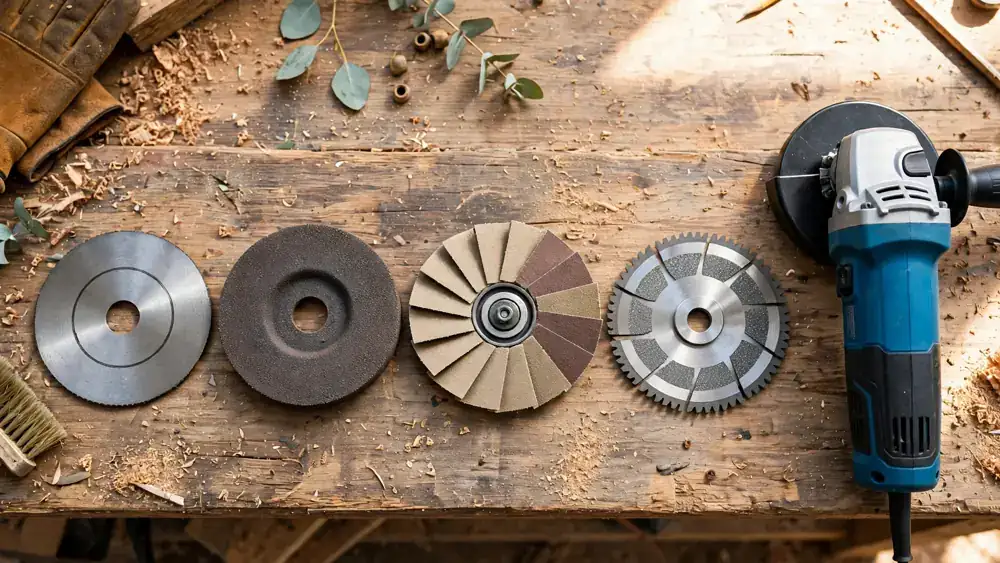
Walk into any hardware aisle and the wall of angle grinder disc types can look like alphabet soup: cut-off wheels, grinding discs, flap discs, diamond blades and wire wheels. Most people grab whatever is cheapest and hope for the best — and that is how discs shatter and a five-minute job turns into a trip to the emergency department.
An angle grinder is only as good as the disc on it. Match the disc to the material and the job and a cheap 115 mm grinder will cut steel, dress a weld and clean a rusty gate. This guide covers every common disc type, the sizes sold in Australia, what they cost at Bunnings, and the safety rules.
Angle Grinder Disc Anatomy in 60 Seconds
Every disc carries the same basic features. The diameter (100, 115, 125, 180 or 230 mm) must match your grinder — never fit a bigger disc than the grinder is rated for. The bore is the centre hole, 22.23 mm on almost every disc sold in Australia. The maximum RPM printed on the disc must be at or above your grinder’s no-load speed; a disc rated below it can fly apart.
Type 27 is a flat or slightly depressed-centre disc, the standard shape for cutting and grinding wheels. Type 29 is a conical flap disc, angled so the flaps meet the work correctly. Check the disc is rated for your material: steel, stainless steel (marked “Inox”), aluminium or masonry.
Angle Grinder Disc Types at a Glance
Pick the row that matches your job, not the disc closest to hand.
| Disc type | Best for | Never use for |
|---|---|---|
| Cutting (cut-off) disc | Slicing steel bar, sheet, pipe and bolts | Grinding on its side |
| Grinding disc | Removing welds, bevelling edges | Cutting through material |
| Flap disc | Grinding and finishing in one pass | Deep cutting |
| Diamond blade | Concrete, brick, tile and stone | Cutting steel |
| Wire brush wheel | Removing rust, paint and scale | Cutting or grinding metal |
| Carbide wood disc | Shaping and carving timber | Metal, masonry or fast cuts |
The Main Angle Grinder Disc Types
Cutting discs: thin, fast and strictly for cutting
A cutting disc — also called a cut-off wheel — is a thin bonded abrasive wheel, usually 1.0 to 1.6 mm thick on a 115 mm grinder, built to slice through metal with minimal material loss. The thin profile means less friction and a narrower kerf. The trade-off is fragility: a cutting disc has almost no side strength and cuts at 90 degrees only.
Never grind on the side of a cutting disc. Side pressure flexes the thin wheel and can snap it without warning — the most common cause of angle grinder injuries in home workshops. Use 1.0 mm discs for sheet metal and thin tube, and 1.6 mm for heavier bar and angle iron. DeWALT’s 115 mm x 1.2 mm thin-cut discs sell as a 10-pack tin for $16.75 at Bunnings.
Grinding discs: the heavy lifters
A grinding disc is the thick, rigid cousin of the cutting disc — typically 6 mm thick on a 115 mm grinder — built to take side pressure and remove metal fast. This is the disc for dressing weld beads flat, bevelling an edge before welding and cleaning up flame-cut edges. The depressed-centre (Type 27) shape lets you grind at a shallow angle.
Coarse grits around 24 to 36 remove weld metal fast and leave a rough surface; 40 to 60 grit is the general fabrication range. A grinding disc removes metal faster than a flap disc but leaves a rougher finish. Never use a grinding disc to cut through material — it is too thick, too slow and it binds.
Flap discs: grind and finish in one pass
A flap disc is made of overlapping abrasive cloth flaps bonded around a fibreglass backing plate. As the flaps wear, fresh abrasive is continuously exposed, so the disc keeps cutting evenly instead of glazing over. It grinds and finishes in one operation, with less heat and a smoother surface than a bonded grinding disc.
Flap discs are the most versatile disc in a general workshop: they remove welds, blend seams, deburr edges, strip rust and prep metal for paint. Zirconia cuts more aggressively and lasts longer on steel and stainless; aluminium oxide is cheaper and fine for lighter work. Grit 40 takes welds down fast, 60 is the all-rounder, and 80 to 120 gives a paint-ready finish. A Full Boar 115 mm zirconia 3-pack (40, 80 and 120 grit) sells for $15.98 at Bunnings.
Diamond blades: concrete, brick and tile
A diamond blade is a steel disc with diamond grit bonded into its rim, and it cuts materials standard abrasives cannot handle: concrete, brick, pavers, roof tiles and porcelain. There are three rim styles. A continuous rim gives a smooth, chip-free edge for tiles and porcelain. A segmented rim cuts fastest and runs coolest, making it the pick for concrete and brick. A turbo rim balances speed and finish.
The range at Bunnings is wide: a Full Boar 115 mm turbo rim blade is $16.98, Kango’s 115 mm continuous rim is $22.99 and its turbo is $25.49, while Diablo’s 115 mm range runs from $38.21 for the turbo to $52.46 for the segmented turbo. For a one-off tiling job, the budget end is fine; for regular concrete cutting, the dearer blades last longer. Diamond blades cannot cut steel — they glaze and overheat.
Wire brush wheels: rust and paint removal
A wire brush wheel is a cup or wheel of crimped or knotted steel wire that strips rust, scale, loose paint and spatter from steel without removing much base metal — the right tool for cleaning a rusty trailer chassis or gate frame before repainting. Knotted wire suits heavy rust; crimped wire is gentler. Wire wheels throw wires, so wear a face shield, not just safety glasses, and check the wheel before each use.
For paint and coatings, a strip and clean disc — a thick, open-webbed non-woven disc — removes paint, epoxy and surface rust without gouging the metal underneath, which is what you want when stripping a panel for repainting.
Wood carving discs: useful, but respect them
Carbide-toothed wood discs turn an angle grinder into a fast shaping tool for timber — bowl carving, sculpting, and hogging out material that would take forever with a chisel.
Treat these discs with respect. An angle grinder has no chain brake and no guard designed for wood cutting, and a kickback on a wood disc is violent. Use both hands, a firm stance and the guard fitted, and never fit a circular saw blade or a chainsaw chain disc to an angle grinder — those combinations cause some of the worst workshop injuries in Australia. If the job is really a cutting job, reach for a circular saw.
Angle Grinder Disc Sizes in Australia
Disc size follows grinder size, and the common sizes in Australia are 100, 115, 125, 180 and 230 mm. The 115 mm (4.5 inch) grinder is the home-workshop standard: light, easy to control, and with the widest disc range at Bunnings. The 125 mm is the trade favourite, and the 180 and 230 mm grinders are heavy machines for thick steel.
The bore is almost always 22.23 mm, so a 115 mm disc fits any 115 mm grinder regardless of brand. What changes is the maximum RPM: a 115 mm disc is typically rated to 13,300 RPM while a 230 mm disc is rated to 6,600 RPM. Never fit a disc rated below your grinder’s speed. If you are still choosing the grinder itself, our angle grinder buying guide covers sizes, power and cordless versus corded. Our drill bits explained guide covers which bit suits steel, masonry and timber.
What Angle Grinder Discs Cost in Australia
Live Bunnings prices checked 17 November 2026 — a guide to the range, not a quote.
| Disc | Bunnings price (17 Nov 2026) |
|---|---|
| DeWALT 115 mm x 1.2 mm thin-cut metal discs, 10-pack | $16.75 |
| Full Boar 115 mm zirconia flap discs, 3-pack (40/80/120 grit) | $15.98 |
| Full Boar 115 mm turbo rim diamond blade | $16.98 |
| Kango 115 mm continuous rim diamond blade | $22.99 |
| Diablo 115 mm segmented turbo diamond blade | $52.46 |
A basic cutting or flap disc costs a few dollars each, and a diamond blade costs several times more. A disc is cheaper than the hospital visit a worn or wrong disc causes — replace discs at the first sign of cracking or heavy wear.
Safety Rules That Are Not Optional
Angle grinders injure more home DIYers than almost any other power tool. Never grind with a cutting disc, and never cut with a grinding disc. A cutting disc has no side strength and a grinding disc is too thick to cut safely.
Check the disc before every use. Look for cracks, chips and missing segments, and tap a bonded disc gently — a sound disc rings, a cracked one thuds. Check the maximum RPM and expiry date on the label. A disc dropped on concrete is a disc you throw away. Keep the guard on and wear the gear: safety glasses at minimum, a face shield for grinding and wire brushing.
Control the dust. Cutting concrete, brick, tile or stone makes respirable crystalline silica dust, which causes silicosis. Australia’s workplace exposure standard is 0.05 mg/m³ over an 8-hour shift, and since September 2024 the rules require controlled processing — wet cutting, on-tool extraction or ventilation. At home that means cutting wet or with a vacuum attachment and wearing a P2 respirator. SafeWork SA’s crystalline silica guidance sets out the controls.
Angle Grinder Disc Types: Our Verdict
If you own one angle grinder and do general home and shed work, five discs cover almost everything: a 1.0 mm cutting disc for sheet and thin tube, a 1.6 mm cutting disc for bar and angle iron, a 6 mm grinding disc for welds and edges, a 60-grit zirconia flap disc for blending and rust removal, and a wire brush wheel for cleaning.
The disc is the tool. A $60 grinder with the right disc beats a $300 grinder with the wrong one, every time. Buy discs by the job and replace them before they fail.
Angle Grinder Disc Types: FAQs
Can I use a cutting disc for grinding?
No. A cutting disc is thin and has almost no side strength. Grinding on its side flexes the wheel and can snap it without warning.
What is the difference between a flap disc and a grinding disc?
A grinding disc is a solid bonded wheel that removes metal fast and leaves a rough finish. A flap disc is made of overlapping abrasive flaps that grind and finish in one pass, with less heat and a smoother surface. Use a grinding disc for heavy removal and a flap disc for blending.
What size angle grinder disc do I need?
Match the disc to your grinder: 115 mm is the home-workshop standard, 125 mm is the trade favourite, and 180 or 230 mm suits heavy work. The bore is 22.23 mm on almost every disc sold in Australia.
Can a diamond blade cut steel?
No. Diamond blades are made for concrete, brick, tile and stone. On steel they glaze over, overheat and cut very slowly. Use a bonded metal cutting disc for steel and keep diamond blades for masonry.
How long does an angle grinder disc last?
It depends on the disc and the work. A thin cutting disc can last a few cuts in heavy steel or dozens in thin sheet; a flap disc lasts until the flaps wear to the backing plate. Replace any disc at the first sign of cracking, wobbling or heavy wear, or a printed expiry date that has passed.
Do I need a special disc for stainless steel?
Yes. Use discs marked “Inox” for stainless steel. Standard steel discs contain iron and sulphur that contaminate stainless and cause rust spots.