What Size Chainsaw Do I Need? Bar Length Guide for Aussie Yards
Picking the right what size chainsaw starts with one measurement: the bar. Get the bar length right and the saw feels easy — it cuts cleanly, balances well and stays under control. Get it wrong and the same job turns into a fight: a bar too short binds, a bar too long drags the saw around and tires your arms. This guide matches bar length to the wood you actually cut, with live Bunnings prices checked 16 November 2026.
Key Takeaways
- For most Aussie homeowners, a 16-inch bar is the sweet spot for pruning, storm cleanup and firewood up to about 30 cm across.
- Your bar should be at least 5 cm (2 inches) longer than the thickest wood you cut most weeks.
- A bar can cut wood nearly twice its own length by cutting from both sides.
- Longer bars need more power: a 20-inch bar on a small motor bogs down, while the same bar on a 50cc-plus saw earns its keep.
- First saw? Start at 14 or 16 inches — lighter, easier to control.
What Size Chainsaw at a Glance
| Job you do most | Bar length | Wood size | Power type |
|---|---|---|---|
| Pruning small branches | 10–12 inches | Up to 15 cm | Battery or corded |
| Garden cleanup and limbing | 14 inches | Up to 25 cm | Battery or small petrol |
| Firewood and general yard work | 16 inches | Up to 30 cm | Battery or petrol |
| Regular firewood, bigger logs | 18 inches | Up to 35 cm | Petrol or big battery |
| Felling and large hardwood | 20 inches and up | Over 40 cm | Petrol, 50cc and up |
What Size Chainsaw Do I Need? The 2-Inch Rule
The 2-inch rule is the simplest answer to what size chainsaw you need: the bar should be at least 5 cm (2 inches) longer than the diameter of the wood you cut most often. A 16-inch bar is therefore the right match for logs up to about 30 cm across, because the bar clears the far side of the cut and the tip does not get pinched. Cutting wood much wider than the bar forces angled cuts, and that is when the bar binds.
Measure the wood, not the tree: the thickest branches and logs you cut in a normal month. Most suburban blocks top out at 20 to 30 cm — pruned gum branches, storm-fallen limbs, firewood rounds. That points straight at a 14 or 16-inch bar.
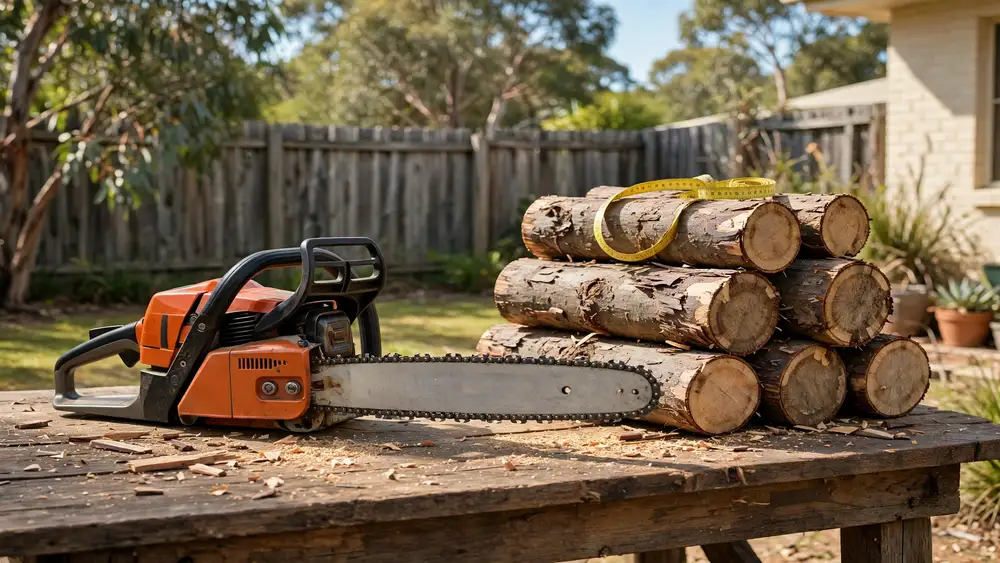
A bar can also cut wood nearly twice its own length: cut through one side, roll the log, and cut through from the other side, and a 16-inch bar handles a 50 cm trunk. You need a 20-inch bar only if you cut big wood every week.
Bar Lengths Explained: 10 Inches to 20 Inches and Beyond
Bar length is measured from where the bar leaves the saw body to the tip — the number printed on the bar itself. A longer bar cuts wider wood in one pass, but adds weight and kickback exposure, and asks more of the motor.
A 10 to 12-inch bar is a pruning and cleanup size: light, easy to carry, ideal for branches up to about 15 cm. The Ryobi 36V 12-inch top-handle kit is $599 at Bunnings, but top-handle saws are for trained arborists, not beginners.
A 14-inch bar is the light all-rounder: it prunes, limbs and cuts firewood rounds up to about 25 cm, and stays light enough for an hour’s work.
A 16-inch bar is the Australian homeowner standard, covering pruning, storm cleanup and firewood up to about 30 cm. The Ryobi 36V HP 16-inch 4Ah kit is $549 at Bunnings; the tool-only version is $399 if you already own 36V batteries.
An 18-inch bar is the firewood step-up: logs up to about 35 cm in a single pass, for a trailer load each winter. The Ryobi 36V 18-inch tool-only saw is $469 at Bunnings.
A 20-inch bar and beyond is felling and farm territory: logs over 40 cm in one pass, on saws with the power to drive them — 50cc petrol and up. The Echo CS-590 Timber Wolf runs a 20-inch bar on a 59.8cc engine. No AU price verified for the CS-590 — check with a local dealer.
What Size Chainsaw for Firewood?
Firewood is the job that decides bar length for most rural and semi-rural buyers. If you buy cut rounds and just buck them to length, a 16-inch bar covers rounds up to 30 cm. If you cut your own from fallen trees, red gum and ironbark rounds over 40 cm are common — that pushes you toward 18 or 20 inches.
Volume matters as much as diameter: one trailer load a winter is a 16-inch job; every weekend through winter is an 18 or 20-inch job. Runtime matters too — a 4.0Ah battery gives roughly 30 to 90 minutes of hard cutting, while a petrol saw refuels in a minute. Our battery vs petrol chainsaw guide compares runtime, noise and running costs.
A sharp chain matters more than an extra two inches of bar: a dull chain on a 20-inch bar cuts slower than a sharp chain on a 16-inch bar. If your saw is cutting slowly, sharpen first and upsize second. Our chainsaw maintenance guide covers sharpening, tension and bar oil.
What Size Chainsaw for Felling Trees?
Felling is where bar length stops being a shopping question and becomes a safety question. The bar must nearly cut through the trunk from one side — a two-sided felling cut on a leaning tree is harder to control. For trees up to 40 cm across, an 18-inch bar is the minimum sensible choice; over 50 cm, a 20-inch bar or longer is the honest answer, on a 50cc-plus saw.
Felling a large tree is not a first-saw job: if you have never felled a tree, use the saw you own to cut it into sections after a professional drops it. A big bar in inexperienced hands is the most dangerous combination in this guide — more tip, more leverage, harder kickback. Take a chainsaw course before felling anything bigger than a sapling, and read the SafeWork SA chainsaw safety guidance first.
Bar Length vs Power: Matching the Two
A bar is only as good as the motor driving it: a long bar on a weak saw slows the chain, strains the motor and binds more easily.
On petrol, the rough pairing is: up to 35cc suits 12 to 14-inch bars, 35 to 45cc suits 14 to 16-inch bars, and 50cc and up suits 18 to 20-inch bars and beyond. The Stihl MS 170 is a 30.1cc homeowner saw sold with 12 to 16-inch bars. The Husqvarna 135 Mark II runs a 38cc engine with a 16-inch bar as standard and takes 14 to 16-inch bars. No Australian price could be verified for either saw — check with a local dealer.
On battery, voltage and amp-hours do the same job as cubic centimetres. A 36V saw with a 4.0Ah pack drives a 16-inch bar comfortably — Ryobi rates its 16-inch kit at up to 60 cuts into 200 mm Australian hardwood on that pack. EGO rates its 16-inch CS1611 as equal to a 40cc petrol saw, with a chain speed of 20 metres per second. An 18-inch bar wants the bigger pack: Ryobi’s 18-inch kit runs a 6.0Ah battery. A small battery on a long bar works, but slowly.
Weight, Balance and Kickback: Why Longer Is Not Always Better
Every extra inch of bar adds weight at the far end of the saw, and that weight works against you: the longer the bar, the more it pulls the saw’s nose down and the harder your arms work. After an hour of cutting, a 20-inch bar feels very different from a 16-inch one, and tired arms make sloppy cuts.
Kickback risk grows with bar length too: when the bar tip catches the wood, a longer bar puts more tip in the danger zone and gives the kick more leverage. Shorter bars are more forgiving for beginners for exactly this reason — that is the strongest argument for starting at 14 or 16 inches: easier to control means safer.
What Size Chainsaw Costs in Australia
Bar length and price rise together, but not by much at the homeowner end. Real Australian prices, checked 16 November 2026:
| Saw | Bar | Price |
|---|---|---|
| Ryobi 36V HP 12-inch top-handle 4Ah kit | 12 inches | $599 |
| Ryobi 36V HP 16-inch 4Ah kit | 16 inches | $549 |
| Ryobi 36V HP 16-inch tool only | 16 inches | $399 |
| Ryobi 36V HP 18-inch tool only | 18 inches | $469 |
Note the pattern: the 16-inch kit at $549 costs less than the 12-inch top-handle kit at $599, because the top-handle saw is a specialist tool, not a bigger saw. And the $70 jump from a 16-inch tool-only saw ($399) to an 18-inch one ($469) is cheap insurance if you cut 35 cm logs every week, and wasted money if you do not.
Skins save money if you already own batteries: the 16-inch tool-only saw at $399 is $150 less than the kit, because the kit’s battery and charger are the expensive part. Our battery chainsaw reviews cover which battery models hold their pace best.
How to Measure a Chainsaw Bar
You need the measurement right when you buy a replacement chain. Bar length is measured from where the bar exits the saw body to the tip — not the full length of the metal, which includes the tail hidden inside the saw. A bar stamped 16 inches measures about 16 inches from the body to the tip.
Three numbers matter when you replace a bar or chain: the bar length, the chain pitch and the chain gauge. Pitch is the distance between chain links (commonly 3/8-inch low profile on homeowner saws); gauge is the drive-link thickness (commonly 1.3 mm). Both are stamped on the bar near the tail, with the drive link count. All three must match the new chain exactly — a wrong pitch or gauge is dangerous, not just a poor fit. Check your manual before ordering.
Decision Guide: Five Questions Before You Buy
- How thick is the wood? Measure the thickest logs you cut most weeks — under 25 cm means 14 inches, under 30 cm means 16 inches, over 35 cm means 18 inches or more.
- How often do you cut? Once a month suits 14 or 16 inches; every weekend suits 18 inches; all-day firewood suits a 20-inch petrol saw.
- What is your experience? First saw means 14 or 16 inches — lighter and more forgiving on kickback.
- Petrol or battery? Battery covers 12 to 18-inch bars for home use; petrol is the pick for 20-inch bars and big hardwood. Our top gas chainsaws guide covers the petrol picks.
- Do you already own batteries? Ryobi 36V packs make a $399 skin the cheap choice over a $549 kit.
The Verdict
For most Australian homeowners, the what size chainsaw question has a clear default answer: 16 inches. It is long enough for pruning, storm cleanup and firewood up to 30 cm, light enough to use for an hour, and cheap enough that the best battery kits sit under $550. Step down to 14 inches for light pruning only, step up to 18 inches for weekly firewood, and save 20 inches for felling and hardwood over 40 cm.
Frequently Asked Questions
What size chainsaw do I need for firewood?
For most firewood, a 16-inch bar is enough — it cuts rounds up to about 30 cm in one pass. Over 35 cm, step up to 18 inches; over 40 cm, use 20 inches on a 50cc-plus petrol saw.
What size chainsaw is best for a beginner?
A 14 or 16-inch rear-handle saw is the best first chainsaw: light, easy to control and forgiving on kickback. Avoid top-handle saws as a first buy — they are for trained arborists.
Can a chainsaw cut wood wider than its bar?
Yes — cut through one side, roll the log, and cut through from the other side. A 16-inch bar handles a 50 cm trunk this way.
Is a longer bar better?
Not always. A longer bar cuts wider wood in one pass, but it is heavier, harder to control and more exposed to kickback, and it needs a bigger motor or battery. It only helps when the wood you cut most weeks is genuinely wider than a shorter bar can handle.
What size chainsaw do I need for pruning?
A 12 or 14-inch bar is all you need for pruning — it handles branches up to about 25 cm and stays light enough to work overhead.
How do I know what bar length my chainsaw takes?
Check the bar itself: the length, chain pitch, gauge and drive link count are stamped near the tail. Your manual also lists the bar range it accepts — the Husqvarna 135 Mark II takes 14 to 16-inch bars. Match all three exactly when buying a replacement chain.
Measure the wood, then buy the bar. A 16-inch saw covers nearly every Aussie yard — and a sharp chain on a 16-inch bar out-cuts a dull chain on a 20-inch bar every time.