Best Belt Sander Australia: 5 Picks for Every Job
A belt sander removes timber roughly ten times faster than a random orbital sander, and that speed is both the reason to own one and the reason to respect it: held still for two seconds, it cuts a hollow you will spend twenty minutes sanding out. The best belt sander Australia buyers can pick is the one that matches the job — a cheap corded 76mm sander for stripping a deck, a cordless skin for site work on a platform you already own, or a Makita or DeWalt for daily trade use. Five picks below, from $84.90 to $441, with prices checked at Bunnings on 26 November 2026.
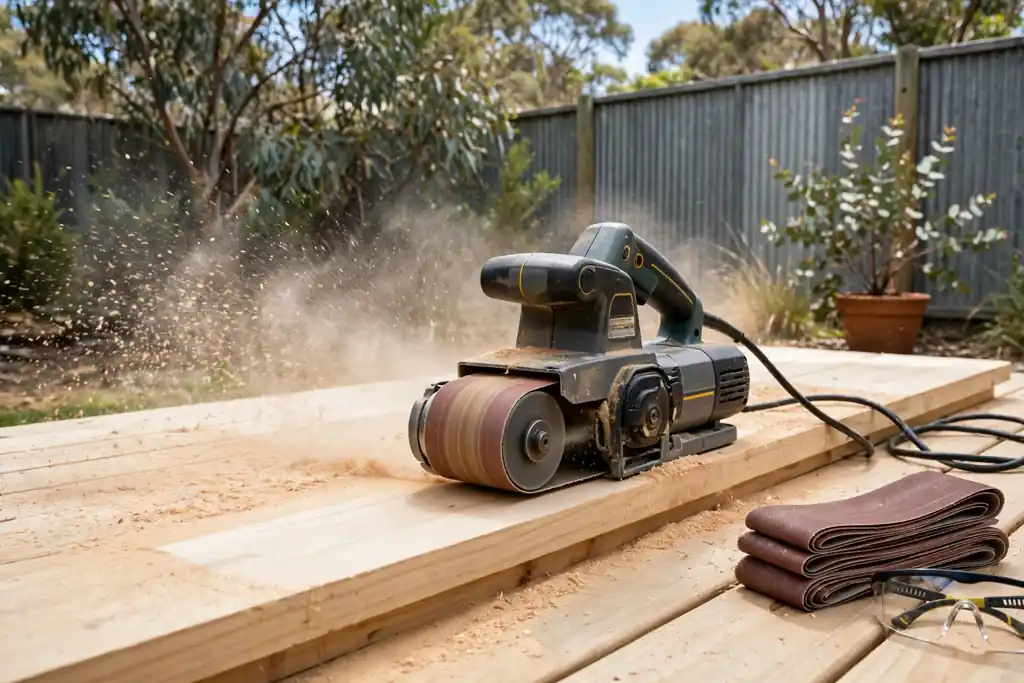
A belt sander is a loop of abrasive cloth running over two drums, and it is the only sander that levels as well as it smooths. The belt cuts in one direction, so it takes down high spots, strips paint and varnish, and flattens a benchtop in a way an orbital sander — which cuts in tiny circles — never will. The trade-off is aggression: a belt sander with 40-grit paper will eat through a millimetre of hardwood in a single pass, so control comes from movement, not pressure.
Best Belt Sander Australia: The Shortlist
| Model | Power | Belt | Price 26 Nov 2026 |
|---|---|---|---|
| Ozito 800W Belt Sander BSR-7000 | 800W corded | 76mm | $84.90 |
| Ryobi 800W 76mm Belt Sander RACBS7500 | 800W corded | 76mm | $149 |
| Ryobi 18V ONE+ Belt Sander R18BS-0 (skin) | 18V cordless | 76mm | $189 |
| Makita 76mm Belt Sander 9910SP | Corded | 76mm | $297 |
| DeWalt 18V Brushless Belt Sander DCW220N-XJ (skin) | 18V cordless | 75mm | $441 |
Every pick here runs a 75 or 76mm belt, which is the standard Australian size — belts are cheap and available at every hardware store, unlike the odd sizes that lock you into one supplier. The short version: the Ozito strips a deck for the price of a carton, the Ryobi corded is the best-value workshop sander, and the Makita and DeWalt are the ones that survive daily use.
How to Use a Belt Sander Without Ruining the Timber
The rule is one sentence: keep it moving and let the weight do the work. Start the sander before it touches the timber, lower it onto the surface while it is already travelling, and keep it travelling in long, overlapping passes along the grain until you lift it clear — never start or stop it while the belt is sitting on the wood. Pressing down harder does not sand faster; it loads the belt, heats the timber and cuts a dip.
Grit progression matters more than the sander. Strip paint or level a rough board with 40 or 60 grit, step to 80, then finish at 120 — and never skip more than one grade, because each grade exists to remove the scratches of the one before it. Jumping from 40 straight to 120 leaves deep scratches the fine belt cannot reach, and the finish looks worse than if you had stopped at 80. For a deck, that progression is the difference between a floor that takes oil evenly and one that shows every pass.
Dust extraction is not optional on a belt sander. A 76mm belt at full speed throws a remarkable amount of dust, and the dust bag most sanders ship with catches perhaps half of it. Hook the sander to a vacuum where you can, wear a P2 mask where you cannot, and never sand MDF or treated pine without one — the dust from both is not something to breathe.
Best Belt Sander Australia: The 5 Picks
1. Ozito 800W Belt Sander BSR-7000 — Best for Occasional Stripping
The Ozito BSR-7000 is the cheapest belt sander on an Australian shelf: 800W, a 76mm belt, and $84.90 at Bunnings. It is a straightforward corded machine with no variable speed and no soft start, and it does exactly one job — removing material fast — at a price that makes hiring one look expensive. For stripping a deck, flattening a benchtop or taking paint off a door, it is all the sander most homes need. Its limits are the ones the price implies: a basic dust bag, a motor that works hard under load, and a build that suits a few weekends a year rather than a workshop that runs daily. At $84.90, it is a disposable-price tool that usually lasts years anyway.
2. Ryobi 800W 76mm Belt Sander RACBS7500 — Best Value Workshop Sander
The Ryobi RACBS7500 is the middle of the corded range: 800W, a 76mm belt, and $149 at Bunnings. It adds the refinements the Ozito lacks — better dust collection, a more comfortable grip and a steadier feel under load — without doubling the price. It is the pick for a home workshop that sands a few times a month: decks, benchtops, furniture restoration, the jobs where a belt sander earns its shelf space. It runs on a lead, so it suits the shed rather than the site, and it shares nothing with Ryobi’s 18V ONE+ batteries — this is a corded tool, priced and built as one.
3. Ryobi 18V ONE+ Belt Sander R18BS-0 — Best Cordless for ONE+ Owners
The Ryobi R18BS-0 is the cordless pick for anyone already on the ONE+ platform: an 18V belt sander sold as a skin at $189 at Bunnings, running on the same batteries as more than 100 other ONE+ tools. It trades raw power for freedom — no lead, no outlet hunting, easy work on a ladder or at a job halfway down a fence line. Its limit is runtime: a belt sander draws hard, so a single 5.0Ah battery gives a working session rather than a working day, and the skin price is not the full cost if you need batteries as well. If you already own ONE+ batteries, it is the most convenient sander here; if you do not, the corded Ryobi at $149 is the cheaper buy.
4. Makita 76mm Belt Sander 9910SP — Best for Daily Workshop Use
The Makita 9910SP is the tradie’s belt sander: a 76mm corded machine at $297 at Bunnings, built around a motor and a flat platen that stay true under load. What the extra $150 over the Ryobi buys is not power but consistency — the belt tracks straight, the platen stays flat, and the sander does the same pass on the hundredth board as it did on the first. That matters when the finish is the product, as it is for a furniture maker or a floor sander. Makita’s belt sanders have been workshop staples in Australia for decades, and parts and belts for them are available everywhere, which is worth more than a feature list when the tool is earning its keep.
5. DeWalt 18V Brushless Belt Sander DCW220N-XJ — Best Cordless Trade Sander
The DeWalt DCW220N-XJ is the premium cordless pick: an 18V brushless belt sander with a 75mm belt, sold as a skin at $441 at Bunnings. The brushless motor runs cooler and longer than the brushed motors in the cheaper cordless tools, and the variable speed lets you slow the belt for fine finishing work rather than running flat out for every pass. It is the most expensive tool here and the most capable cordless one — the pick for a tradie who sands on site all week and already runs DeWalt 18V XR batteries. Bunnings lists the full belt sander range if you want to compare it against the corded options side by side.
Belt Sander or Random Orbital Sander?
Buy a belt sander for removing material and a random orbital for finishing it — they are different tools, not rivals. The belt sander levels, strips and shapes; the orbital sander smooths and finishes without leaving directional scratches. Most workshops need both, and the belt sander usually comes second, after the orbital has handled the finishing work on a few projects and the owner discovers how slow it is at stripping a deck.
If you can only own one sander, own the random orbital: it finishes every job, even if it strips slowly. If you already own one, the belt sander is the next purchase, and the $149 Ryobi is the point where it starts paying for itself. Read our best random orbital sanders guide for the finishing side of the pair, and our best jigsaws guide for the cutting tool that usually shares the same bench.
Belts, Platens and the Parts That Wear Out
Belts are a consumable, and cheap belts are a false economy: a good belt cuts faster, runs cooler and lasts three times as long as a bargain one, which means fewer belt changes and a better finish. Buy the grit you use — 40, 60, 80 and 120 cover most work — and keep a spare of each, because a belt always tears halfway through a job on a Sunday.
Best Belt Sander Australia: FAQs
What is a belt sander used for?
A belt sander removes material fast: stripping paint and varnish, levelling rough timber, flattening benchtops and sanding decks. Its loop of abrasive belt cuts in one direction, so it levels high spots that an orbital sander cannot. It is a shaping and stripping tool first and a finishing tool second — most jobs finish with an orbital sander after the belt sander has done the heavy work.
What size belt sander do I need?
A 75 or 76mm belt is the standard Australian size and suits almost every home and trade job, from deck stripping to furniture work. Smaller belts suit detail work and larger 100mm belts suit floor sanding, but the 76mm size has the widest belt choice and the cheapest consumables. Buy the standard size unless you have a specific reason not to.
Can I use a belt sander on a deck?
Yes — it is one of the best tools for it. Start with 40 or 60 grit to strip the old finish and level the boards, then step through 80 to 120 grit before oiling. Keep the sander moving along the boards, never across them, and never let it sit still on the timber. Sweep the deck first: a single hidden screw head will tear a belt and gouge the board.
Is a cordless belt sander worth it?
If you already own batteries on that platform and you sand away from power points, yes — the convenience is real. If you are buying batteries as well, a corded sander gives you more power for less money, and a belt sander is usually used near the workshop anyway. Compare the skin price plus batteries against the corded price before deciding.
Why does my belt sander leave marks on the timber?
Usually one of three causes: the sander stopped moving while the belt was running, which cuts a hollow; the grit was too coarse for the finish stage; or the belt is tracking off-centre and its edge is digging in. Keep the sander moving, step through the grits without skipping a grade, and adjust the tracking so the belt runs centred on the drums.
The best belt sander Australia choice is a simple one: the $84.90 Ozito if the job is a single deck, the $149 Ryobi if the workshop sands monthly, the $189 Ryobi skin if your batteries are already ONE+, and the Makita at $297 or the DeWalt at $441 if the sander earns its keep every week. Whichever you buy, keep it moving, step through the grits, and let the belt do the work.