Best Power Station for Camping Australia: 5 Picks for Every Trip
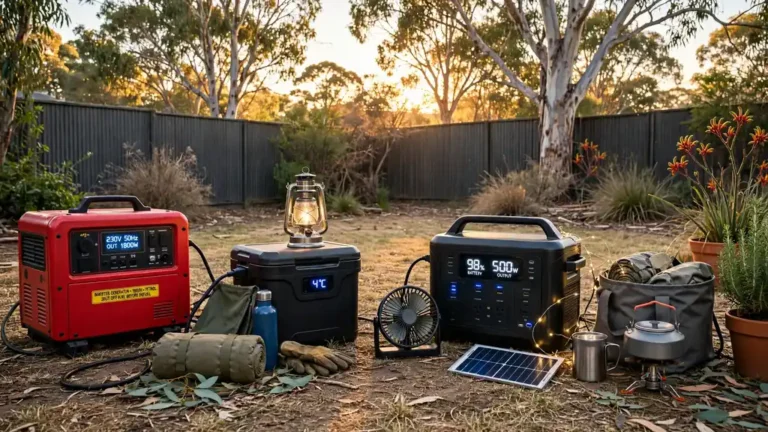
A power station has replaced the generator as the camping essential: no fuel, no fumes, no noise complaints from the next tent over. The best power station for camping Australia is not the biggest one you can afford — it is the smallest one that covers your actual loads, because every extra watt-hour is weight you carry to the tent and back. This guide picks five models from 245Wh to 1,024Wh, with prices checked on Australian manufacturer stores on 19 November 2026.
All five use lithium iron phosphate (LiFePO4) batteries, which hold roughly 80% of their capacity after 3,000 charge cycles — about 10 years of regular use.
Best Power Station for Camping Australia: The Shortlist
| Model | Capacity | AC output | Weight | Price 19 Nov 2026 |
|---|---|---|---|---|
| EcoFlow River 3 | 245Wh | 300W | 3.5 kg | $299 |
| Jackery Explorer 300 Plus | 288Wh | 300W | 3.75 kg | $699 |
| EcoFlow River 2 Max | 512Wh | 500W | 6 kg | $599 |
| EcoFlow River 3 Max Plus | 858Wh | 600W | 10.8 kg | $799 |
| Anker SOLIX C1000 Gen 2 | 1,024Wh | 2,000W | 11.3 kg | $899 (sale) |
The short version: the River 3 covers phones, lights and a laptop for a night or two; the River 2 Max adds a small fridge for a weekend; the River 3 Max Plus covers two or three days off-grid; the Anker runs a kettle or a 240V appliance at base camp.
How Much Power Do You Actually Need for Camping?
Start from your loads, not from a capacity number. A phone takes about 10–15Wh for a full charge, a laptop about 50–80Wh, a 10W LED camp light about 10Wh per hour, and a 12V camping fridge draws roughly 40W on average once it is cold.
Then knock about 20% off the headline capacity: inverter losses mean roughly 80% of the rated watt-hours are usable as AC power, so a 512Wh station gives you about 410Wh of real use. Divide that by your daily need for your days off-grid. Roughly: 250–300Wh covers phones, lights and a laptop for a night or two; 500Wh adds a small fridge for a weekend; 1,000Wh covers a fridge and a 240V appliance for two or three days. For your exact gear, our generator and power station sizing calculator runs the same sums.
Best Power Station for Camping Australia: The 5 Picks
1. EcoFlow River 3 — Best for Light, Short Trips
The River 3 is the smallest and cheapest station here: 245Wh, 300W of AC output (600W with X-Boost), and 3.5 kg. It charges from empty in an hour from a wall outlet, takes up to 110W of solar, and has a 100W USB-C port. It is the only pick with an IP54 rating against dust and water, and EcoFlow rates it under 30 dB. EcoFlow’s Australian store lists it at $299, less than half the price of the next-cheapest pick. Its limit is capacity: a 40W fridge gets roughly five hours from it, so it is a devices-and-lights station, not a fridge station — buy it for overnighters and car camping.
2. Jackery Explorer 300 Plus — The Expensive One to Think Twice About
The Jackery Explorer 300 Plus is a good station with a bad Australian price: 288Wh, 300W, 3.75 kg, two 100W USB-C ports, and a LiFePO4 battery Jackery rates at 3,000 cycles with a five-year warranty. Jackery says it runs a 90W fridge for 2.5 hours. The problem is the $699 price on Jackery’s Australian store — more than double the lighter River 3, which takes more solar (110W against 80W) and costs $299. Its one real edge is dual 100W USB-C ports. If you already own Jackery panels, or find it on sale well under $500, it is a sound unit; at full price, the River 3 does the same job for $400 less.
3. EcoFlow River 2 Max — Best for a Weekend With a Fridge
The River 2 Max is the sweet spot for most campers: 512Wh, 500W of continuous AC output (1,000W with X-Boost), about 6 kg, and $599. It charges from empty in an hour on mains power and takes up to 220W of solar, refilling in as fast as three hours of good sun. Its five-year warranty is the longest cover here. On the usable-energy rule it gives you about 410Wh: roughly 10 hours on a 40W camping fridge, or a full weekend of phones, lights and laptop with the fridge running overnight. If you buy one station for Australian camping and run a fridge, this is it.
4. EcoFlow River 3 Max Plus — Best for Two or Three Days Off-Grid
The River 3 Max Plus pairs the River 3 Plus with an EB600 extra battery for 858Wh, with 600W of AC output (1,200W surge and X-Boost) and IP54 protection. At 10.8 kg it is a car-boot unit, and it costs $799. That 858Wh gives you about 686Wh of usable energy — roughly 17 hours on a 40W fridge, or two days of fridge plus devices with a solar top-up. It refills in about 4.8 hours from 220W of solar, or 1.8 hours from a wall outlet. The extra battery clips on without cables and works on its own, so the stack splits into a 286Wh day unit and a 572Wh spare. Buy it for longer stays and family trips, or where you cannot recharge by driving each day.
5. Anker SOLIX C1000 Gen 2 — Best for Base Camp and 240V Gear
The Anker SOLIX C1000 Gen 2 is the heavyweight: 1,024Wh, 2,000W of continuous AC output, 11.3 kg, and a battery rated at 4,000 cycles to 80% capacity. It is the only pick that will run a kettle or a toaster at camp, and its roughly 819Wh of usable energy gives about 20 hours on a 40W fridge. The price needs a careful read: Anker’s Australian store lists it at $899 in its Black Friday sale (10 November to 12 December 2026) against a $1,599 recommended price, and BCF lists the same station at $1,399 outside the sale. Inside the sale window it is the best value per watt-hour here at about $0.88. It is the heaviest pick, so it suits a caravan or a base camp you drive to. Buy it in the sale window for 240V appliances at camp; otherwise the River 3 Max Plus covers the same job for $100 less.
What Size Power Station for a Camping Fridge?
The fridge decides your size, because it runs all day while everything else charges in bursts. The table assumes a camping fridge drawing 40W on average, counting only the roughly 80% of capacity that reaches your gear as usable AC power.
| Model | Usable energy (approx.) | Hours on a 40W fridge |
|---|---|---|
| EcoFlow River 3 | 196Wh | 5 hours |
| Jackery Explorer 300 Plus | 230Wh | 6 hours |
| EcoFlow River 2 Max | 410Wh | 10 hours |
| EcoFlow River 3 Max Plus | 686Wh | 17 hours |
| Anker SOLIX C1000 Gen 2 | 819Wh | 20 hours |
A fridge draws far more on a hot day and after you load warm food into it, so pre-chill it at home and load it cold. A solar panel changes the maths too: a 100W panel putting in 60–70W of real power covers a 40W fridge and still trickles charge into the station — which is how a 512Wh unit lasts a whole weekend instead of a single night.
Solar Panels for Camping Power Stations
Match the panel to roughly a quarter of the station’s capacity in watts: 100W for the small stations, 160–220W for the 500–1,000Wh ones. EcoFlow’s figures say the River 3 refills in as fast as 2.6 hours from a 110W panel, the River 2 Max in three hours from 220W, and the River 3 Max Plus in 4.8 hours from 220W. The Jackery 300 Plus takes 6.3 hours from an 80W panel — slow enough that a bigger panel is worth it.
Foldable panels pack down small; rigid panels are cheaper per watt but need roof space. Check the panel’s voltage against the station’s solar input range, and keep the panel in the sun while the station sits in the shade — heat shortens battery life.
Power Station or Generator for Camping?
A power station wins on noise, fumes and rules: no exhaust, so you can run it beside the tent, and at under 30 dB the EcoFlow units are quieter than a conversation. A generator wins on total energy — a litre of fuel holds far more watt-hours than any battery you can carry — so for a week off-grid with a big fridge and air conditioning, a generator still makes sense.
Generator use in Australian national parks is patchy: Queensland prohibits generators in most national parks, and where they are allowed the limit is typically 65 dB at 7 metres and 2.0 kVA, with set hours. Other states set their own hours and bans park by park, and no generator is allowed on a Total Fire Ban day. A power station has none of those restrictions. If you camp in national parks, that alone settles it; on private land, the choice is about how many days you stay out. Our generator vs power station comparison covers the same trade-off in detail.
Best Power Station for Camping Australia: FAQs
What size power station do I need for camping?
For phones, lights and a laptop over a night or two, 250–300Wh is enough. Add a fridge and you want around 500Wh for a weekend, or around 1,000Wh for two to three days with a fridge and a 240V appliance. Pick the smallest station that covers two days of your daily watt-hours.
How long will a power station run a camping fridge?
On a fridge drawing 40W on average, a 245Wh station lasts about five hours, a 512Wh station about 10 hours, an 858Wh station about 17 hours, and a 1,024Wh station about 20 hours — counting only the roughly 80% usable as AC power. Pre-chill the fridge and add a solar panel to stretch any of them across a weekend.
Can I take a power station on a plane?
No, not these five. Airlines cap spare lithium batteries at 160Wh, and the smallest station here is 245Wh, so none of them can fly as carry-on or checked luggage. Drive them to camp instead, and keep them upright and out of direct sun in the car.
Can I charge a power station while it powers the fridge?
Yes. All five support pass-through charging, so you can plug a solar panel or a car charger in while the fridge runs off the station. That is the normal way to camp with one: panel by day, fridge overnight, and the station tops back up while you drive.
Should I buy a power station or a generator for camping?
Buy a power station if you camp in national parks, value silence, or stay out for one to three days. Buy a generator if you stay out for a week, run air conditioning, or need far more energy than a battery can carry. Many campgrounds restrict or ban generators; none bans a power station.
How long do LiFePO4 power stations last?
All five use LiFePO4 batteries rated at 3,000 charge cycles to 80% capacity — about 10 years of regular camping use. The Anker is rated higher, at 4,000 cycles. That long life is the main reason to buy LiFePO4 over older lithium-ion stations, which faded after roughly 500 cycles.
For most campers, the best power station for camping Australia is the EcoFlow River 2 Max at $599: the cheapest here that runs a fridge for a full weekend, charges in an hour, and carries with one hand. If you only need devices and lights, save the $300 and take the River 3; if you stay out longer or run 240V gear, step up to the River 3 Max Plus or the Anker in its sale window. For the wider field beyond camping, see our best portable power stations Australia guide.