Best Rotary Hammer Drill Australia: 5 SDS-Plus Picks
Five rotary hammers cover the whole Australian market, from a $75 corded Ozito kit to Milwaukee’s $729 M18 FUEL flagship — and the right one depends on hole size, not brand. The best rotary hammer drill Australia buyers can pick is the one whose impact energy matches the holes they actually drill: a 2-joule class tool handles 6 to 10mm fixings in brick, a 3.5-joule tool handles 12 to 16mm holes in concrete, and only the 4.9-joule Milwaukee in this guide is built for regular 20mm-plus drilling and light chiselling. Prices below were checked on Bunnings and Total Tools on 23 November 2026.
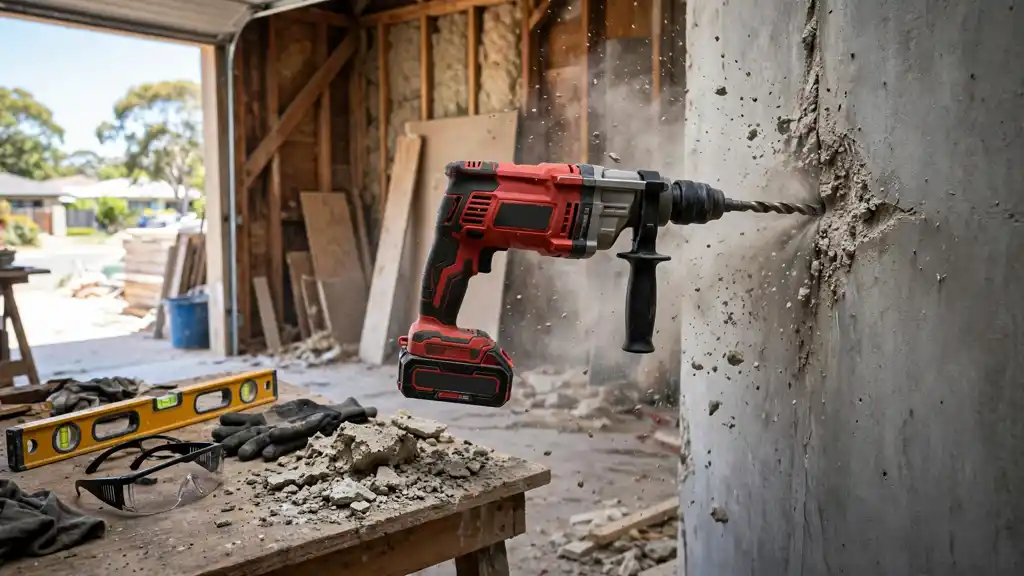
A rotary hammer is not a hammer drill with a bigger motor. A standard hammer drill rattles the chuck back and forth; a rotary hammer drives a piston that strikes the bit directly, so each blow lands harder and the bit does the work instead of your arms. That is why a rotary hammer drills a 12mm hole in concrete in seconds where a hammer drill takes minutes and burns bits. The trade-off is weight, noise and cost — and the fact that it is a one-job tool, brilliant at masonry and useless everywhere else.
Best Rotary Hammer Drill Australia: The Shortlist
| Model | Power | Impact energy | Price 23 Nov 2026 |
|---|---|---|---|
| Ozito 900W SDS+ Rotary Hammer Kit | 900W corded | 3.5J | $75 |
| Ryobi 1500W SDS+ Rotary Hammer RSDS1500-K | 1,500W corded | — | $129 |
| Ryobi 18V ONE+ SDS Rotary Hammer (skin) | 18V cordless | — | $149 |
| AEG 18V 26mm FUSION SDS+ Rotary Hammer (skin) | 18V cordless | — | $399 |
| Milwaukee M18 FUEL 28mm SDS Plus M18FHP-0 (skin) | 18V cordless | 4.9J | $729 |
The short version: buy corded if you drill masonry a few times a year, buy cordless if you already own the batteries, and buy the Milwaukee only if you drill concrete weekly. Two of the five are corded kits with bits included; three are cordless skins, so check the battery maths before comparing prices.
How Much Hammer Do Your Holes Need?
Impact energy, measured in joules, is the number that decides drilling speed in concrete. Each blow chips a little concrete away from the bottom of the hole, and more joules per blow means fewer blows per hole. The relationship is not linear — doubling the joules does not double the speed — but the bands are clear enough to buy by.
| Impact energy | Holes it handles well | Typical use |
|---|---|---|
| Under 2.5J | 6–10mm fixings in brick and block | Hanging brackets, wall plugs, light DIY |
| 2.5–3.5J | 10–16mm holes in concrete | Renovation, dynabolts, pipe and cable runs |
| 4J and over | 16–28mm holes, light chiselling | Trade concrete work, chasing, anchor bolts |
The other number is the chuck. Every pick here is SDS Plus, which is the standard for drills up to 28mm: the bit slides into the chuck and locks with grooves, so it can move back and forth under impact without slipping. SDS Max is the bigger system for demolition hammers and core drilling above 32mm — if you need it, you need a different machine, not a bigger SDS Plus drill. Do not buy SDS Max bits for an SDS Plus chuck; they do not fit, and adaptors waste the impact energy you paid for.
Best Rotary Hammer Drill Australia: The 5 Picks
1. Ozito 900W SDS+ Rotary Hammer Drill Kit — Best for Occasional Use
The Ozito is the cheapest honest way into rotary hammer drilling: 900W, 3.5 joules of impact energy, three modes — drill, hammer drill and chisel — and a kit that includes 8mm, 10mm and 12mm SDS Plus bits plus a pointed and a flat chisel. Bunnings lists it at $75, which is less than a single tank of fuel for some utes, and for a bathroom renovation or a round of dynabolts it does the job. Its limits are the ones you would expect at the price: a brushed motor, no electronic kickback control, and a build that suits a few weekends a year rather than daily site work. If masonry is a once-a-year job, this is the pick — spend the saving on good bits.
2. Ryobi 1500W SDS+ Rotary Hammer Drill RSDS1500-K — Best Corded Value
The Ryobi RSDS1500-K is the step up for anyone who wants corded power without the trade price: a 1,500W motor, three modes, and a kit format that arrives ready to drill. Bunnings lists it at $129, and the extra 600W over the Ozito shows up as faster drilling in hard concrete and less stalling when the bit hits aggregate. It is heavier than the cordless picks and tied to a lead, which is a fair trade for unlimited runtime — there is no battery to flatten halfway through a run of holes. For a renovator drilling a house full of fixings over a month, the corded Ryobi is the sensible middle of this guide.
3. Ryobi 18V ONE+ SDS Cordless Rotary Hammer Drill — Best for ONE+ Owners
The Ryobi 18V ONE+ SDS rotary hammer is the pick if you already own ONE+ batteries: it is sold as a skin only at $149 at Bunnings, so the real cost depends on what is already in your shed. It drills, hammer-drills and drives fasteners, with an SDS Plus chuck for fast bit changes, and it runs on the same batteries as more than 100 other ONE+ tools. Its limit is output — it sits in the light-duty band, suited to 6 to 12mm holes in brick and block rather than deep concrete work — but for hanging, fixing and light renovation it is the most convenient tool here. If you are starting from nothing, add a battery and charger to the $149 before comparing it with the corded picks; our best battery platform guide works through that maths.
4. AEG 18V 26mm FUSION SDS+ Rotary Hammer Drill A18FRH0 — Best Mid-Range Cordless
The AEG A18FRH0 is the middle of the cordless range: an 18V FUSION brushless SDS Plus rotary hammer with 26mm capacity, sold as a skin at $399 at Bunnings. The brushless motor runs cooler and longer than the brushed motors in the cheaper picks, and 26mm capacity covers dynabolts, anchor bolts and cable penetrations that the lighter cordless tools struggle with. It is the pick for a tradie who drills masonry most weeks but does not need the Milwaukee’s 4.9 joules, or for a serious DIYer who wants one cordless rotary hammer for the next decade. AEG’s FUSION range shares batteries across its 18V tools, so check what else in the range you would use before committing to the platform.
5. Milwaukee M18 FUEL 28mm SDS Plus Rotary Hammer M18FHP-0 — Best for Heavy Concrete
The Milwaukee M18FHP-0 is the heavyweight: 4.9 joules of impact energy, 28mm capacity in concrete, up to 4,600 blows per minute and 800rpm, with AUTOSTOP kickback control and an anti-vibration system. Total Tools lists the skin at $729, and at about 4.0kg before a battery it is the heaviest tool here by a clear margin. That weight is the price of its output: it drills 20mm-plus holes in concrete without bogging down and handles light chiselling that would stall every other pick. It is overkill for hanging a television bracket and exactly right for a concreter or a plumber drilling core holes weekly. Buy it as a skin only if you already run M18 batteries.
SDS Plus Bits: Where the Money Actually Goes
The drill is half the system; the bit is the other half. A cheap SDS Plus bit in hard concrete dulls in a handful of holes, then starts polishing the concrete instead of cutting it — the drill sounds busy and the hole does not get deeper. A quality four-cutter bit costs more and drills straighter, faster and longer, and for the price of one takeaway lunch it can be the difference between a ten-second hole and a ten-minute one.
Rotary Hammer Safety: Kickback, Dust and Noise
A rotary hammer binds when the bit hits reinforcing steel or the hole fills with dust, and a bound bit stops dead while the motor keeps turning — the tool twists in your hands with real force. The Milwaukee’s AUTOSTOP cuts the motor when it senses that twist; the cheaper picks rely on your grip and the side handle. Always use the side handle, keep both hands on the tool, and clear the hole by withdrawing the bit every few seconds so dust does not pack around it.
Concrete dust is silica dust, and it is not harmless. A P2 mask is the minimum for drilling concrete indoors, and a vacuum with a dust shroud is better still — it keeps the dust out of the air and out of the hole, so the bit cuts faster. Ear protection is standard: rotary hammers run loud, and the impact mechanism adds a sharp crack to the motor noise. Our best cordless drills guide covers the lighter drilling jobs where a rotary hammer is more tool than the hole needs, and our drill vs impact driver comparison sorts out which driver belongs in your hand for everything else.
Best Rotary Hammer Drill Australia: FAQs
What is the difference between a rotary hammer and a hammer drill?
A hammer drill rattles the whole chuck back and forth to chip masonry, while a rotary hammer drives a piston that strikes the bit directly with far more force per blow. A rotary hammer drills concrete several times faster and with less effort from the operator. A hammer drill is fine for occasional small holes in brick; a rotary hammer is the right tool for concrete and for repeated masonry drilling.
What does SDS Plus mean?
SDS Plus is the chuck and bit system used on rotary hammers up to 28mm: the bit slides into the chuck and locks with grooves, so it can move back and forth under impact without slipping or needing to be tightened. SDS Max is the larger system for demolition hammers and holes above 32mm, and its bits do not fit an SDS Plus chuck.
How many joules do I need in a rotary hammer?
For 6 to 10mm fixings in brick and block, under 2.5 joules is enough. For 10 to 16mm holes in concrete, look for 2.5 to 3.5 joules. For 16 to 28mm holes and light chiselling, you want 4 joules or more. Buying more joules than your holes need costs money and weight; buying fewer costs time and burnt bits.
Can I use a rotary hammer as a normal drill?
Yes, in drill-only mode with the impact switched off — all five picks here have a rotation-only setting. It is heavier and clumsier than a standard drill, so it suits the occasional hole in timber or steel rather than a day of driving screws. For regular drilling and driving, a cordless drill driver is the better tool.
Should I buy a corded or cordless rotary hammer?
Buy corded if you drill masonry a few times a year and want maximum power per dollar — the $75 Ozito and $129 Ryobi prove the point. Buy cordless if you already own batteries on that platform and you drill away from power points, on ladders or on site. A skin-only cordless price is not the full cost if you need to buy batteries and a charger as well.
The best rotary hammer drill Australia choice comes down to one honest count: how many holes, how big, and how often. A few fixings a year points to the $75 Ozito kit; a house renovation points to the corded Ryobi or the AEG; weekly concrete work points to the Milwaukee. Match the joules to the hole and the platform to the batteries you already own, and the drill will do the rest.