Best Reciprocating Saws Australia: 5 Honest Picks for Demolition, Pruning and Rough Cuts
Shopping for the best reciprocating saws Australia has to offer is harder than it should be. Google the phrase and you'll mostly get retailer category pages and thin overseas listicles — very little genuine buying advice for Aussie conditions. Below: five real models you can actually buy here, what each is genuinely good at, and the buying criteria that matter once the marketing falls away.
Every model below was confirmed as sold in Australia through a major retailer or manufacturer channel. Prices move constantly, so only prices confirmed at a major Australian retailer on publish day are printed below; where no price is shown, check Bunnings, Total Tools or Sydney Tools before buying.
What Is a Reciprocating Saw, and What Is It Actually For?
A reciprocating saw — tradies call it a recip saw, sabre saw or demo saw — drives a straight blade back and forth at thousands of strokes per minute. It's a demolition tool first and a precision tool never. Fit the right blade and it will chew through timber framing, nail-embedded studs, PVC and copper pipe, plasterboard, sheet metal and tree branches.
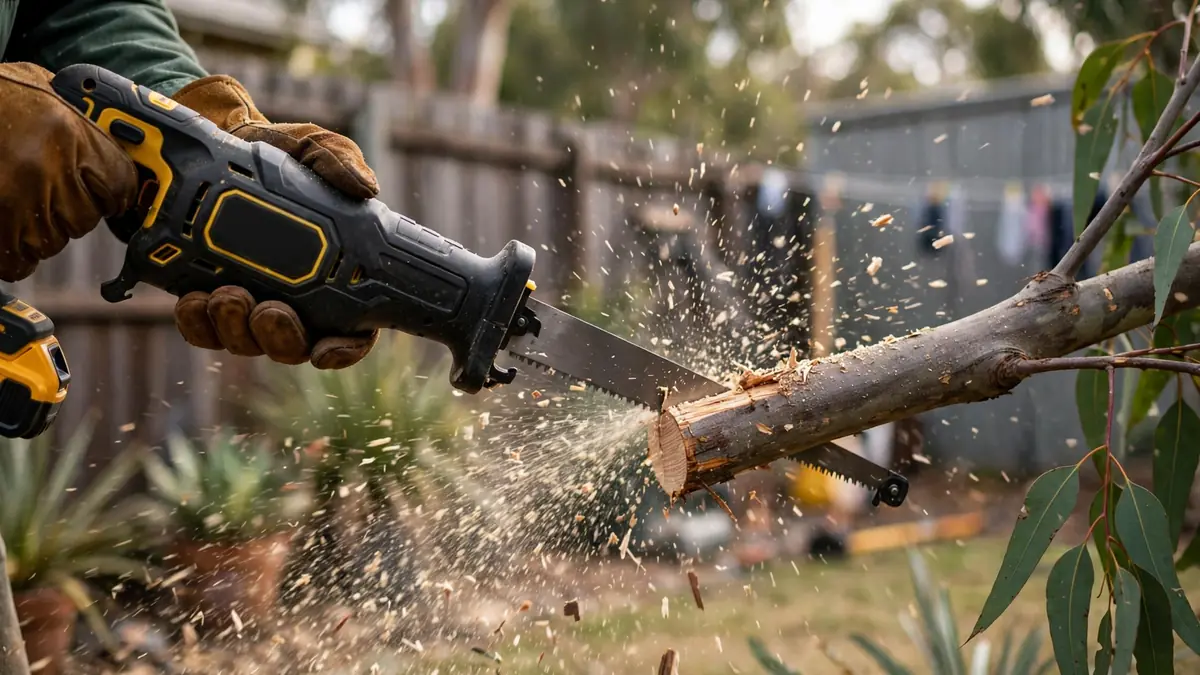
Its three natural habitats are demolition (pulling out old framing, decking and fencing), pruning (branches and roots a chainsaw would be overkill for), and rough cuts where speed beats finesse. What it won't do is cut straight. If the job needs a clean, dead-straight line in sheet material, that's circular saw territory — our guide to the best circular saws for 2026 covers those.
The blade matters as much as the saw. Demolition blades have aggressive teeth and survive nails; pruning blades are longer with deep gullets that clear green wood; bi-metal blades handle metal and mixed materials. Budget for a small blade assortment, not just the single blade in the box.
Corded vs Cordless: Which Should You Buy?
Corded recip saws are cheaper, never run flat, and deliver full power all day — provided there's a power point within extension-lead reach. For a big strip-out next to the house, a corded saw at around a hundred dollars is genuinely hard to argue with.
Cordless saws cost more once you factor in batteries, but the freedom is the whole point: up a ladder, out at the back fence, or halfway through a roof cavity. If you already own that brand's batteries the maths changes completely — a skin-only (tool-only) saw can cost half what the full kit does. Our roundup of the best cordless drills in 2026 compares the major 18V platforms — the platform you picked for your drill is usually the one your saw should live on too.
Short version: buy cordless 18V unless your work always happens within cooee of a power point. Tradies doing all-day demolition should look at the 36V class.
How to Choose the Best Reciprocating Saw in Australia
Strokes per minute (SPM). Most saws here run 0–3,000 SPM, and a variable-speed trigger is non-negotiable — you start cuts slow, especially in metal, then wind it up.
Stroke length. The distance the blade travels each cycle, usually 20–32mm. Longer strokes clear material faster in timber; shorter strokes give more control in metal and tight spots. For general demolition, 28mm and up is the sweet spot.
Orbital vs straight action. Orbital action adds a slight elliptical motion that rips through wood noticeably faster. Straight (linear) action is smoother and better for metal, where you want the blade tracking true. Some saws switch between both; most budget saws are straight-only.
Tool-free blade change. You'll swap blades constantly — wood to metal, demo to pruning. A lever or twist collar beats an Allen key every time. Every pick below has it.
Vibration control. Recip saws shake. Counterbalance mechanisms and rubberised grips genuinely reduce fatigue on long cuts. If you'll use the saw for more than ten minutes at a stretch, this matters more than an extra 200 SPM.
Battery platform (cordless models). The saw is only half the purchase — the battery and charger are the rest. Buying into the platform you already own saves hundreds. Price the full kit, not just the skin.
The 5 Best Reciprocating Saws Australia Has Right Now
1. Makita DJR187Z 18V LXT Brushless — Best for Heavy Demolition
The DJR187Z is the saw you buy when the job involves hardwood sleepers, old bearers and beams. The brushless 18V motor drives a 32mm stroke at up to 3,000 SPM (2,300 SPM low setting), rated for 255mm in wood and 130mm in pipe. A built-in LED and rafter hook round out a properly thought-out site tool.
The honest catch: it's a big unit — roughly 3.4 to 3.7kg with a battery — and the Z suffix means skin-only, so LXT newcomers must budget for batteries and a charger. But if you're already on the Makita 18V LXT platform, this is the most saw for the money in the 18V class.
Key specs: 18V LXT brushless · 32mm stroke · 0–3,000 / 0–2,300 SPM · 255mm wood / 130mm pipe capacity · tool-free blade change · LED work light. Street price: Not printed — check Bunnings, Total Tools or Sydney Tools for today’s price.
2. DeWalt DCS386N-XE 18V FlexVolt Advantage — Best Power Upgrade Path
DeWalt's FlexVolt Advantage trick is genuinely useful: on a standard XR battery it's a strong demo saw; clip on a FlexVolt pack and the electronics unlock up to 50% more power for cuts that bog lesser saws down. The 29mm stroke and 3,000 SPM put it squarely in serious-demolition territory, and the pivoting shoe keeps the cut stable against the workpiece.
It's around 3.5kg bare, and the FlexVolt batteries that unlock its best performance aren't cheap — but if your kit bag is already yellow, this is the logical step up from DeWalt's compact saws.
Key specs: 18V XR brushless (FlexVolt Advantage) · 29mm stroke · 0–3,000 SPM · pivoting shoe · crank-type drive train · skin only. Street price: Not printed — check Bunnings, Total Tools or Sydney Tools for today’s price.
3. Milwaukee M18 FUEL Hackzall M18FHZ-0 — Best One-Handed Saw for Tight Spaces
Plumbers and sparkies swear by the Hackzall format for a reason: one-handed operation leaves your other hand free to hold the pipe. The FUEL brushless motor pushes a 22mm stroke to 3,000 SPM, Milwaukee's FIXTEC clamp swaps blades without tools, and the dual-gear counterbalance keeps vibration noticeably lower than the old brushed Hackzalls. At 2.3–3.3kg with a battery (depending on the pack), it's manageable overhead.
The trade-off is the shorter stroke — in thick timber it's slower than the full-size saws above. Buy this for pipe, conduit and awkward in-place cuts, not for ripping out decking.
Key specs: 18V M18 FUEL brushless · 22mm stroke · 0–3,000 SPM · FIXTEC tool-free blade change · LED · one-handed design. Street price: Not printed — check Bunnings, Total Tools or Sydney Tools for today’s price.
4. Ryobi 18V ONE+ HP Brushless Reciprocating Saw — Best Value Cordless for DIY
Ryobi's HP brushless saw is the pick for the home renovator who already owns ONE+ batteries. It out-specs some trade saws on paper — 3,200 SPM and a 32mm stroke — with tool-free blade changes, a pivoting shoe, an LED and a timber blade in the box.
Vibration control and long-term durability aren't at Makita/DeWalt level, and big ONE+ HP batteries add cost if you're starting from scratch. But for weekend demolition and pruning, it's far more saw than its price suggests.
Key specs: 18V ONE+ HP brushless · 32mm stroke · 3,200 SPM · tool-free blade clamp · pivoting shoe · LED · timber blade included. Street price: $289 (tool only) at Bunnings, checked 24 October 2026.
5. Black+Decker BES301-XE 750W Corded — Best Budget Pick
Sometimes the cheapest honest answer is a cord. The 750W motor runs 0–2,800 SPM through a 20mm stroke, with tool-free blade changes, an adjustable shoe and a removable branch holder that's genuinely handy for pruning. Two blades in the box.
The cord is the limitation — you're tethered to a power point — and the 20mm stroke is shorter than the cordless picks above. But for garden clean-ups, bench work and occasional demolition near the house, it does the job at a price the cordless kits can't touch.
Key specs: 750W corded · 20mm stroke · 0–2,800 SPM · tool-free blade change · adjustable shoe · branch holder + 2 blades included. Street price: Not printed — check Bunnings, Total Tools or Sydney Tools for today’s price.
Best Reciprocating Saws Australia: Side-by-Side Comparison
| Model | Power | Stroke length | Max SPM | Tool-free blade change | Best for |
|---|---|---|---|---|---|
| Makita DJR187Z | 18V LXT brushless | 32mm | 3,000 | Yes | Heavy demolition, sleepers and beams |
| DeWalt DCS386N-XE | 18V XR brushless (FlexVolt Advantage) | 29mm | 3,000 | Yes | Demolition with a power upgrade path |
| Milwaukee M18FHZ-0 Hackzall | 18V M18 FUEL brushless | 22mm | 3,000 | Yes (FIXTEC) | One-handed cuts, plumbing and electrical |
| Ryobi 18V ONE+ HP Brushless | 18V ONE+ HP brushless | 32mm | 3,200 | Yes | DIY demolition and pruning on a budget |
| Black+Decker BES301-XE | 750W corded | 20mm | 2,800 | Yes | Budget garden and bench work near power |
Pruning vs Demolition: Match the Saw to the Job
Most buyers fall into one of two camps, and the right saw differs.
Pruning and garden work. You want light and compact: the one-handed Ryobi HP or the Milwaukee Hackzall, a long pruning blade with deep gullets, and — if you're going corded — the Black+Decker's branch holder, which steadies the saw against the limb. Keep the shoe pressed firmly on the branch and let the blade do the work; forcing it just bends blades.
Demolition and renovation. Go full-size: the Makita DJR187Z or DeWalt DCS386N-XE, an aggressive demolition blade that laughs at nails, and orbital action if your saw has it. Cut with the shoe planted and the speed matched to the material — full noise in timber, backed off in metal to save the blade.
Either way, buy blades for the material in front of you. The saw in the box is only half the tool; the blade is the other half.
Reciprocating Saw Safety: The Non-Negotiables
Recip saws are forgiving, but the blade doesn't care what it touches. Safety glasses and earmuffs every time — these saws are loud and throw chips. Clamp or brace the workpiece, and remove the battery (or unplug) before every blade change, no exceptions.
Before cutting into any wall or old timber, think about what's hidden inside: live wiring and water pipes are the classic nasty surprises. Keep blades sharp, too — a blunt blade makes you push harder, which is exactly when control goes missing. For the full rundown on PPE, dust and workshop habits, see our workshop safety guide for 2026 — and the Housing Industry Association's guide to using hand and power tools safely is a solid external reference.
Frequently Asked Questions
Can a reciprocating saw cut tree branches?
Yes — it's one of the best tools for the job. Fit a pruning blade, plant the shoe firmly against the branch, and let the saw's weight do the work. For anything thicker than your forearm, a chainsaw is faster.
Should I buy a corded or cordless reciprocating saw?
Cordless for freedom — which suits most people. Corded if you always work near a power point and want maximum power per dollar. Battery cost is the hidden half of the cordless price, so price the kit, not the skin.
What blades do I need for a reciprocating saw?
Three cover nearly everything: a demolition blade (aggressive teeth, survives nails) for timber strip-outs, a pruning blade (long, deep gullets) for green wood, and a bi-metal blade (fine teeth) for metal and pipe. Match tooth count to material — fewer, bigger teeth for wood; more, smaller teeth for metal.
Can a reciprocating saw cut metal?
Yes, with a bi-metal blade and the speed backed off. It'll handle pipe, conduit, brackets and nails in timber without complaint. Use cutting oil on thicker steel and go slow — but it's no replacement for an angle grinder on heavy steel.
How do I reduce vibration when using a reciprocating saw?
Keep the shoe pressed hard against the workpiece — most vibration comes from the saw bouncing free. Use sharp blades, don't force the cut, and take breaks on long sessions. If vibration is a regular complaint, a saw with a counterbalance mechanism (like the Milwaukee and DeWalt picks above) is worth the premium.
The bottom line: the best reciprocating saws Australia offers all do the same basic job — pick the one that matches your battery platform and your most common job, then buy the blade assortment and wear the glasses.