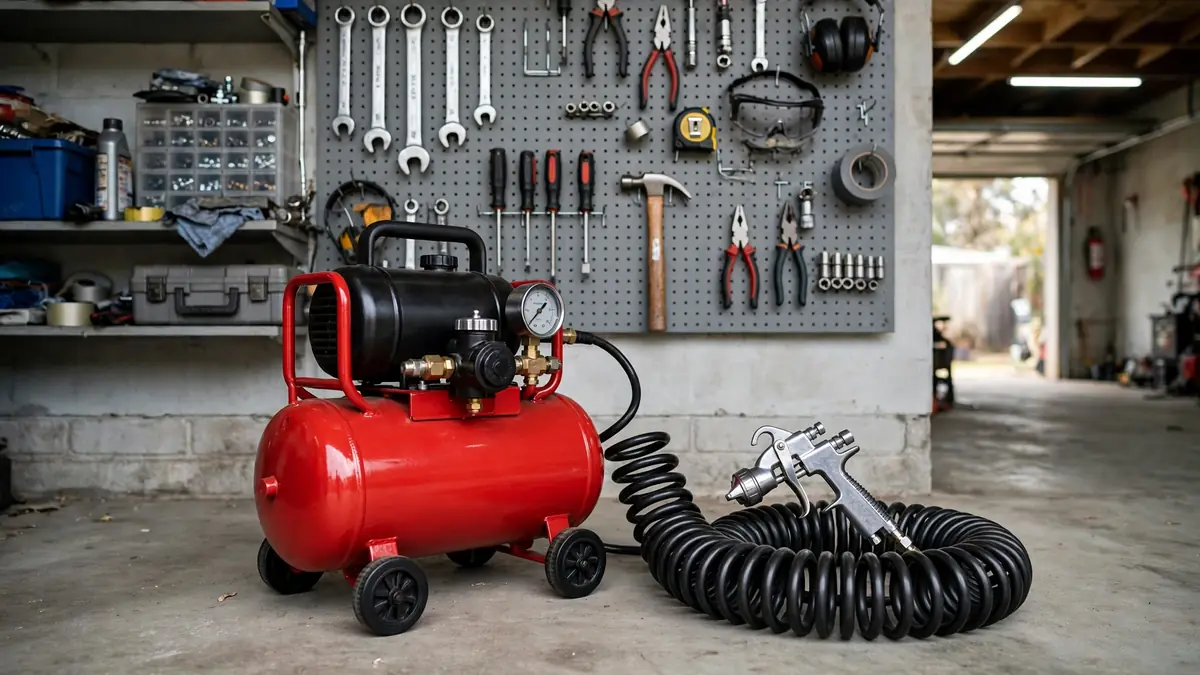
Air Compressor CFM Explained: How to Size a Compressor for Your Tools
Walk the compressor aisle at Bunnings or browse Total Tools online and you'll drown in numbers: CFM, PSI, litres, horsepower, "peak" this and "max" that. Most buyers grab the biggest tank they can afford. That's backwards. If you're asking "what size air compressor do I need", the answer starts and ends with one number: air compressor CFM. Get that right and everything else falls into place. This guide teaches you the sizing maths — the same maths our upcoming CFM calculator will run for you automatically — so you can match a compressor to your tools with confidence.
What Air Compressor CFM Actually Means
CFM stands for cubic feet per minute. It's a measure of flow: how much air the compressor can deliver, continuously, at a given pressure. Think of it like a garden hose. PSI is how hard the water pushes; CFM is how much water actually comes out. A pinhole jet can hit high pressure but fills a bucket slowly. Your air tools work the same way — they need a certain *volume* of air arriving *steadily*, not just a high-pressure puff.
A "7 CFM at 90 PSI" rating means the pump pushes out 7 cubic feet of free air per minute while holding 90 PSI — roughly 200 litres per minute (multiply CFM by 28.3). If your tools collectively demand 8 CFM and your compressor only makes 7, the tank drains faster than the pump refills it, pressure sags, and tools go soft mid-job. No tank size fixes that. Only CFM does.
The Three Numbers That Matter: CFM vs PSI vs Tank Litres
Every compressor spec sheet throws three numbers at you. They do three different jobs, and mixing them up is where most sizing mistakes begin.
CFM — the flow rate
This is the engine of the whole decision: which tools you can run, and how many at once. Size from CFM first, always. If your tool needs 4 CFM and the compressor makes exactly 4, you're at the ragged edge — we'll add headroom shortly.
PSI — the pressure
PSI is the *push* behind the air. Nearly every workshop air tool is designed around 90 PSI (about 620 kPa). The "max PSI" on the box — often 115 or 150 — matters far less than people think, because the regulator steps pressure *down* to the tool's level anyway. The only rule: the compressor's max must clear your tools' required PSI, which any modern unit does.
Tank litres — the reserve
The tank is a buffer, not an engine. It stores pressurised air so the pump can cycle on and off, and it covers short bursts — a nail gun firing a dozen nails — that momentarily exceed the pump's output. It does not mean more CFM: a 100-litre tank on a 4 CFM pump still only delivers 4 CFM. It just takes longer to run flat, and longer to recover.
| Number | What it decides | Bigger means… |
|---|---|---|
| CFM | Which tools run, and how many together | More tools, hungrier tools |
| PSI | Whether tools reach working pressure | Mostly irrelevant past 90–115 |
| Tank litres | Burst cover and motor rest time | Fewer pump cycles, longer bursts |
Why Air Compressor CFM Is Quoted at 90 PSI
Here's the trap: CFM changes with pressure. The same pump might deliver 9 CFM at 40 PSI but only 6 at 90, because pushing harder slows flow. Shonky marketing prints the biggest number — CFM at low pressure — in big type on the box.
The industry settled on CFM at 90 PSI because that's where air tools work — nailers, impact wrenches, grinders and spray guns are all rated there, and manufacturers like Atlas Copco publish their Australian sizing charts on that basis. Rule: only compare CFM figures quoted at the same pressure, and make 90 PSI your anchor. If a spec sheet hides the test pressure, treat the number with suspicion.
Also know the difference between *displacement* CFM (theoretical piston sweep) and *free air delivery* (what actually reaches your tool). Reputable specs quote delivered CFM. If a bargain unit's figure looks impossibly generous for its motor, you're reading displacement.
Typical Air-Tool CFM Requirements
Every calculation starts with your tools' appetites. These typical draws come from manufacturer sizing charts (Atlas Copco Australia, Air Works Compressors, eindustrify) — starting points only. Always check your own tool's data plate, because models vary.
| Tool | Typical CFM | Typical working PSI |
|---|---|---|
| Brad nailer | 1–2 | 70–90 |
| Framing nailer | 1–2 | 70–90 |
| Blow gun | ~3 | 70–90 |
| Tyre inflator | 2–3 | 100–150 |
| Air ratchet | 3–5 | 90–100 |
| ½″ impact wrench | 4–5 | 90 |
| Conventional spray gun | 4–8 | 30–50 |
| HVLP spray gun | ~15 | 40–60 |
| Die grinder | 4–7 | 70–90 |
| Pneumatic angle grinder | 5–8 | 90 |
| Pneumatic random-orbit sander | 8–12 | 90 |
Note the pattern: nailers and blow guns are lightweights, while sanders and grinders are the hungry ones — a pneumatic sander can want three times an impact wrench's air, *continuously*. If sanding or spray painting is in your future, size for it now rather than buying twice.
For a deeper walkthrough of these figures from the manufacturer's side, Atlas Copco's Australian compressor sizing guide publishes the same reference table and explains how pressure, flow, and application fit together.
Duty Cycle: The Maths Most Guides Skip
Duty cycle is the share of time a compressor can run without overheating. 50% duty cycle means 5 minutes on, 5 minutes off. Many affordable direct-drive units sit around 50%; belt-drive pumps run 75% or higher.
The box CFM is the *pumping* rate — output while running. Tools don't care about the pump's rest breaks, so convert:
Effective continuous CFM = rated CFM × duty cycle
An 8 CFM @ 90 PSI unit on 50% duty only sustains 4 CFM continuously. Run a 4 CFM sander off it and you're at the limit with zero margin — in a hot January shed, that's thermal-cutout territory. Flipped around: a 50% duty-cycle compressor must be rated at roughly twice your tools' continuous draw. This one calculation explains half the "can't keep up" complaints you'll hear in any workshop.
Intermittent tools get relief: a nailer might average 20–30% of its rated draw across a session, and the tank covers the bursts while the pump catches up. Continuous tools — sanders, grinders, spray guns, die grinders — get no such mercy: size them at full draw.
The Air Compressor CFM Sizing Formula
The sizing itself is one line of arithmetic:
(Total CFM of tools running at the same time) × 1.3 to 1.5 = required compressor CFM at 90 PSI
Step by step:
- List tools you'll run simultaneously — not everything you own. One person, one tool is the honest home-garage baseline.
- Write each tool's typical CFM from its plate or the table above.
- Add them up.
- Multiply by 1.3–1.5. Use 1.3 for intermittent tools on a decent duty cycle; 1.5 for continuous tools, low duty-cycle pumps, long hose runs, or a likely second tool down the track.
- Check duty cycle against the result: required continuous CFM ÷ duty cycle = the rated CFM you actually need on the box.
That margin covers fitting leaks (every workshop has them), hose and filter pressure drop, hot-weather losses, and the next tool you'll inevitably buy.
Tank Size: Burst Capacity vs Continuous Air
With CFM decided, the tank choice is simple — its job is burst capacity and pump rest, nothing more:
- Intermittent tools (nailers, blow guns, tyre inflation): 20–50 litres is plenty — the pump refills between bursts.
- Mixed use (impact wrench, ratchet, occasional nailing): 50 litres suits most home garages.
- Continuous tools (sanders, grinders, spray guns): 100 litres+ — but the tank only *delays* the inevitable. Sustained CFM must come from the pump; a big tank on a small pump just means longer waits.
Bigger tanks also take longer to fill and hold the motor on longer per cycle — noticeable on a standard 10-amp circuit. Don't buy tank you don't need.
Worked Example: Framing Nailer + Blow Gun
Common scenario: framing a deck with a framing nailer while a mate dusts timber with a blow gun.
Step 1 — tool CFM: nailer ≈ 2 CFM typical, blow gun ≈ 3 CFM typical. (Check both plates first.)
Step 2 — simultaneous total: 2 + 3 = 5 CFM.
Step 3 — headroom: both intermittent, but two operators — take 1.4: 5 × 1.4 = 7 CFM at 90 PSI.
Step 4 — duty cycle: an 8 CFM @ 90 PSI candidate on 50% duty sustains 4 CFM, but average draw here is far lower — nailers sip between bursts — so the 50 L tank covers peaks and the pump keeps up. Verdict: 8 CFM @ 90 PSI with a 50 L tank handles this pair comfortably.
Change one variable — swap the blow gun for a pneumatic sander at 10 CFM continuous: 2 + 10 = 12 × 1.5 = 18 CFM at 90 PSI, more than double. Lesson: the hungriest continuous tool dominates. Size for it, or run it alone.
Common Air Compressor CFM Sizing Mistakes
- Shopping by tank litres instead of CFM. The tank is a bucket; CFM is the tap. A big bucket with a dripping tap still leaves you waiting.
- Comparing CFM quoted at different pressures. "10 CFM" at 40 PSI can be weaker than "7 CFM" at 90 PSI. Anchor every comparison at 90 PSI.
- Ignoring duty cycle. A 50% duty cycle halves the effective continuous output. Budget compressors live here — do the multiplication.
- Chasing maximum PSI. Your regulator will feed tools ~90 PSI regardless. Max PSI beyond 115 buys you nothing for air tools.
- Forgetting the second operator. Handing a helper a blow gun can double demand instantly. Add simultaneous tools honestly.
- Buying on horsepower alone. HP hints at motor size, not delivered air — read the CFM @ 90 PSI line.
Electric vs Petrol: What Works in an Australian Garage
240V electric suits nearly every home garage: most single-phase units up to ~2.2 kW run on a standard 10-amp outlet. Bigger ones need a 15-amp outlet — an electrician's job, not a DIY adapter. Belt-drive pumps run noticeably quieter than direct-drive oil-free ones — worth it if the shed shares a house wall.
Petrol compressors earn their keep off-grid: building sites, farms, remote sheds. Louder, heavier, exhaust fumes — never indoors — plus fuel and engine maintenance. The only option on site; overkill in suburbia.
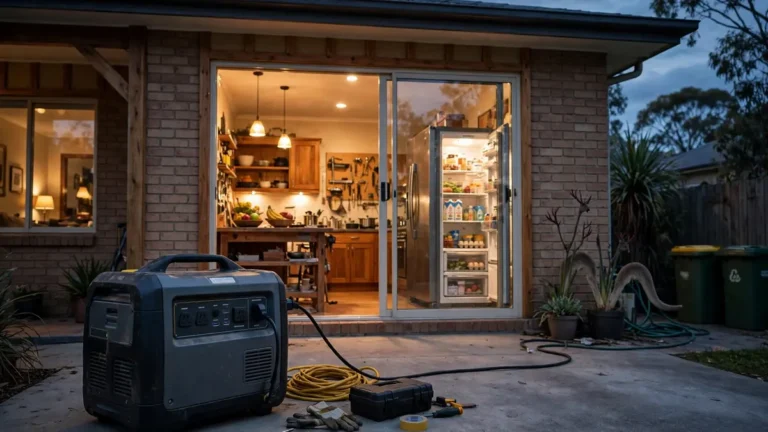
Running an electric compressor off a portable generator? Both have starting-current surges, so the pairing needs its own maths — our Australian generator sizing guide applies the same add-it-all-up logic to watts instead of CFM. To run the numbers automatically, try our generator sizing calculator.
Safety footnote: drain the tank after use (trapped moisture rusts tanks from the inside), never exceed rated pressure, and treat it as the pressure vessel it is — our workshop safety guide covers the habits.
Frequently Asked Questions
What size air compressor do I need for a home garage?
For nailing, blow guns and tyre inflation, 4–7 CFM at 90 PSI with a 20–50 litre tank covers most home garages. Sanding or spraying? Size for those specifically — they can want 10–15 CFM alone, a different class of machine.
What does "CFM at 90 PSI" on the box actually mean?
It's the delivered airflow while holding 90 PSI at the outlet. CFM falls as pressure rises, so a 40 PSI figure looks bigger than the same machine's 90 PSI figure. Always compare at the same pressure — 90 PSI is the standard because that's where tools operate.
Can I run two air tools at the same time?
Yes, if the maths works: add both CFMs, × 1.3–1.5, and check against rated CFM at 90 PSI (duty-cycle adjusted). A nailer plus a blow gun suits a mid-size unit; a sander plus a grinder needs serious CFM.
Does a bigger tank give me more CFM?
No. The tank stores air; the pump makes it. A bigger tank stretches bursts and rests the pump, but once stored air is gone, output equals pump CFM — nothing more. Tools going soft after a minute means you need CFM, not litres.
Why does my impact wrench feel weak when the gauge still reads 90 PSI?
Classic CFM starvation: the gauge shows *static* tank pressure, but under load a small pump can't sustain the *flow*, so pressure at the tool collapses on the trigger. Fix it with more delivered CFM — or a shorter, wider hose — not more tank pressure.
Next step: now you know your CFM number, choosing the machine is straightforward — our 2026 air compressor buying guide picks through the options. Try the maths yourself with our air compressor CFM calculator.