EcoFlow vs Bluetti: Which Power Station Suits Australia?
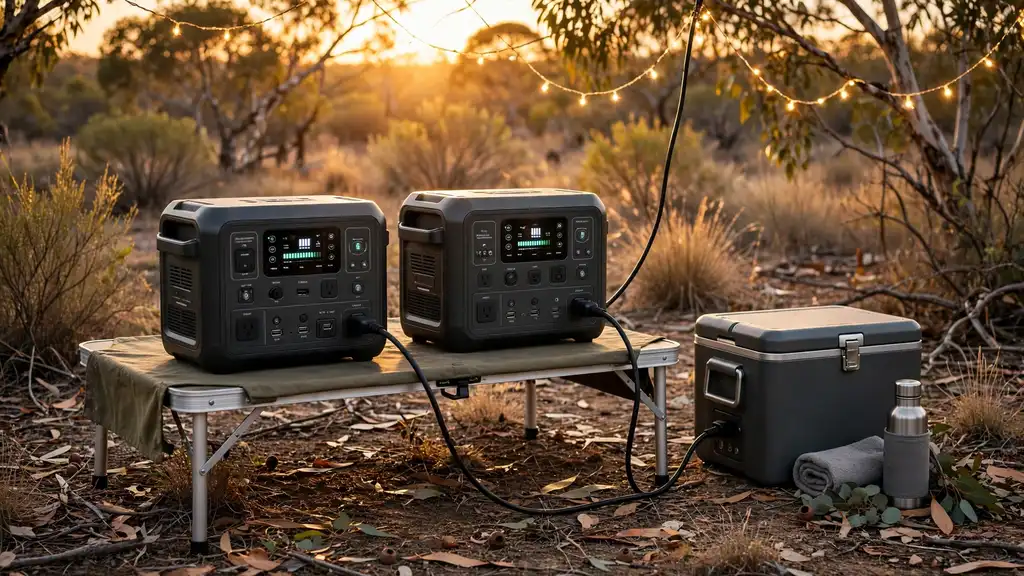
EcoFlow vs Bluetti is the comparison almost every Australian power station buyer ends up making, because these two brands anchor the serious end of the market. Both build lithium iron phosphate (LFP) stations with honest specs and local stores. Both will run a fridge, charge everything you own and keep a campsite civilised. Yet they make different trade-offs on capacity, weight, charging and price — and the right pick depends on which trade-off suits your life.
This EcoFlow vs Bluetti comparison uses the models Australians actually cross-shop: EcoFlow’s DELTA 2 and DELTA 2 Max against Bluetti’s AC180 and its bigger-battery successor, the AC180P. Prices and specs below were checked on 23 October 2026 against EcoFlow’s Australian store and Australian retailers Jaycar and Road Tech Marine, and they move often — treat them as a dated snapshot, and size your loads first with our generator and power station sizing calculator so you know which class you are even shopping in.
EcoFlow vs Bluetti: the headline specs
| Model | Capacity | AC output | Weight | Price checked (AUD) |
|---|---|---|---|---|
| EcoFlow DELTA 2 | 1,024 Wh | 1,800 W (2,700 W surge) | 12 kg | $899 at EcoFlow AU (was $1,199) |
| Bluetti AC180P | 1,440 Wh | 1,800 W (2,700 W Power Lifting) | 17 kg | $1,349 at Jaycar / Road Tech Marine |
| EcoFlow DELTA 2 Max (1900) | 1,900 Wh | 2,400 W (4,800 W surge) | 23 kg | $1,799 at EcoFlow AU |
The original Bluetti AC180, still widely listed, carries 1,152 Wh at the same 1,800 W output; the AC180P is the version on Australian shelves today with the capacity lifted to 1,440 Wh. Check which one a listing actually describes before comparing prices — the shared name causes real confusion.
Capacity and value per watt-hour
On stored energy per dollar, the two leads are close. The DELTA 2 at $899 for 1,024 Wh works out to about $0.88 per watt-hour. The AC180P at $1,349 for 1,440 Wh is about $0.94 per watt-hour. EcoFlow is slightly cheaper per unit of energy at today’s prices, but Bluetti gives you forty percent more energy in the box — which matters more than the unit price if your fridge needs to survive a full day and night. Our generator sizing guide shows how to turn your appliance list into a daily watt-hour figure; match that number to a station and the value question answers itself.
Expansion separates them further. EcoFlow lists the DELTA 2 as supporting an extra battery — a DELTA 2 or DELTA Max extra battery — so the platform can grow after purchase. The AC180P is a fixed-capacity unit: what you buy is what you carry. If your needs are stable, fixed is simpler. If you are building towards home backup, expandable is the safer bet.
Output, charging and the daily reality
Both lead models run 1,800 W AC inverters, enough for kettles, microwaves, power tools and fridges, with surge or lifting modes rated to 2,700 W for motor starts and resistive loads. On output alone there is no winner at this class; the DELTA 2 Max steps up to 2,400 W if you need more.
Charging is where Bluetti lands a punch. Jaycar’s listing for the AC180P rates its AC input at 1,440 W and claims 0 to 80 percent in 45 minutes. EcoFlow rates the DELTA 2’s AC charging at 1,200 W — fast by any normal standard, a touch behind on paper. Solar input caps at 500 W on the DELTA 2 per EcoFlow’s specifications. In camp, both will refill from a decent panel setup across a sunny day; in a blackout, both will gulp wall power quickly enough that the difference rarely decides anything.
Weight might. At 12 kg the DELTA 2 is a genuine one-person carry between car, tent and house. At 17 kg the AC180P is luggable rather than portable — fine from a vehicle, noticeable up stairs. If the station lives in a caravan or a garage, ignore this paragraph. If it hikes between floors and campsites, the five-kilo gap is the whole argument.
Running power tools and workshop loads
Tool users judge these stations differently from campers, because a circular saw or a small air compressor brings a start-up surge that a fridge never matches. Both lead models wear a 1,800 W continuous rating with headroom to 2,700 W, which starts a typical 1,200 W circular saw comfortably and gives a fighting chance with smaller compressors — but surge ratings are momentary, and a compressor that cycles under pressure is the load most likely to expose the limit. If workshop work is the main job, the honest answer in this EcoFlow vs Bluetti comparison is to step up a class: EcoFlow’s DELTA 2 Max lifts continuous output to 2,400 W with a 4,800 W surge rating, which is where tool use stops being marginal. Match the tool list in the sizing calculator before choosing, because the cheapest station is the one you only buy once.
Home backup: the blackout test
For blackout duty the question flips from watts to hours. Take the worked example from our sizing guide: fridge, lights, TV, laptop, phones and a router drawing 2,590 Wh across a day. Against that load, the DELTA 2’s 1,024 Wh covers roughly a third of the day once losses are counted, the AC180P’s 1,440 Wh gets closer to half, and neither replaces a generator for a multi-day outage without solar input or strict rationing. That is not a criticism of either brand — it is the physics of a portable box. Where the stations earn their place is the first night: silent, instant, safe indoors, keeping the fridge cold and the phones alive while you decide whether the outage is an evening or an event. Households in storm-prone areas often run exactly this pairing — station for the quiet essentials, petrol generator for the long tail — and both brands slot into that plan equally well.
Solar, car charging and life off-grid
Both ecosystems expect to be fed away from the wall. The DELTA 2 accepts up to 500 W of solar input on EcoFlow’s specifications and supports car charging; Bluetti lists four recharging ways for the AC180P — AC, solar, car and generator — on Jaycar’s product page. In practice, a 200 to 400 W panel setup refills either station across a good day of Australian sun, which is why both brands sell panel bundles so heavily. Two cautions apply to both: panel ratings are laboratory numbers, and winter sun at southern latitudes delivers a fraction of the summer figure, so size solar for the season you actually travel. And if alternator charging from the vehicle is part of your plan, confirm the current charger accessory and cabling for the specific model rather than assuming the box includes it.
The ecosystems behind the boxes
A power station is also an app, a warranty pipeline and a shelf of accessories. Both brands offer phone apps for monitoring and control — Bluetti advertises app control on the AC180P’s retailer listings, and EcoFlow lists Wi-Fi and Bluetooth connectivity in the DELTA 2’s specifications. Both sell locally through Australian storefronts with Australian consumer guarantees behind them, which matters more than any spec when a unit misbehaves two years in. Accessory depth currently favours EcoFlow for expansion batteries at this size, while Bluetti’s range answers with more capacity built into the single unit. Neither ecosystem locks you into anything proprietary for charging — standard solar connectors and wall power work with both — so the switch cost between brands is low if your needs change.
Battery chemistry and lifespan
Both brands build these models on LFP cells, the chemistry that has taken over this category for good reason: it tolerates full charges, heat and years of cycling far better than the older lithium-ion packs. EcoFlow rates the DELTA 2 at 3,000 cycles to 80 percent capacity. Either brand’s station, used weekly, should outlast the camping gear around it. Warranty support is comparable — EcoFlow lists a five-year warranty for the DELTA 2 on its Australian store, and Jaycar lists a five-year warranty on the AC180P — so after-sales is not the separator it once was. Full specifications are on EcoFlow’s Australian DELTA 2 page and Jaycar’s AC180P listing.
What about the smaller and larger models?
Both brands sell well beyond the models compared here, and the same brand personalities repeat up and down the ranges. EcoFlow’s line is built around families — the compact RIVER series below the DELTA range and larger DELTA Pro models above it — with extra batteries as the recurring theme. Bluetti counters with a wide spread of fixed-capacity units from small carry models to its large AC200-class and modular home systems. The practical advice is to shop the class your calculator result names rather than the badge: a camper who needs 1,000 Wh gains nothing from a 2,000 Wh unit except weight, and a home-backup buyer who needs 2,400 W of output gains nothing from a bargain 600 W box. Both brands also bundle solar panels aggressively during sales, and a bundle is only good value if the panel size matches your recharge plan — a small panel paired with a big battery is decoration, not a system.
One more ownership point separates the experience more than the hardware: firmware and support. Both brands update their apps and firmware, both have Australian storefronts, and both honour Australian consumer law through local channels. Buy through the Australian store or an Australian retailer rather than a grey import, so the warranty path is the local one the prices in this guide were checked against.
Resale and longevity deserve a mention too, because these are not disposable gadgets. LFP batteries in both lineups are rated for thousands of cycles, so a station bought for camping this summer should still be a useful blackout backup years later, and both brands’ local presence makes accessories, cables and extra batteries easy to source long after purchase. If you plan to keep the unit for a decade, buy the capacity your future loads need rather than the minimum today allows — upgrading means selling and rebuying, while headroom costs nothing to carry except a little weight.
Which one should you buy?
Buy the EcoFlow DELTA 2 if portability, expansion options and the lower entry price matter most. It is the lighter carry, it undercuts the Bluetti per watt-hour at today’s pricing, and the extra-battery path means a camping purchase can grow into home backup.
Buy the Bluetti AC180P if you want the most capacity in a single box at this size and your station mostly travels by vehicle. The extra 416 Wh over the DELTA 2 is a real evening of fridge runtime, and its faster AC charging suits quick turnarounds between trips.
Step up to the DELTA 2 Max if your sizing maths says 1,900 Wh and 2,400 W — running tools or a fuller home backup load — and the budget stretches to $1,799.
Whichever way the EcoFlow vs Bluetti decision lands, run your numbers first. A station sized from a guess is either dead weight or a midnight disappointment, and two minutes with the calculator beats both.
Frequently Asked Questions
Is EcoFlow or Bluetti better for camping in Australia?
For camping, the DELTA 2’s 12 kg weight makes it the easier travel companion, while the AC180P’s 1,440 Wh gives longer fridge runtime between charges. Car-based campers who stay put for days often prefer the Bluetti’s capacity; travellers who move daily often prefer the EcoFlow’s weight.
Can these power stations run a household fridge?
Yes. A fridge runs at roughly 100 to 200 W with a start-up surge near 1,200 W, well inside both models’ 1,800 W output and 2,700 W surge or lifting ratings. Runtime depends on capacity and the fridge’s duty cycle — size it with the calculator for your own fridge’s hours.
Which charges faster, EcoFlow or Bluetti?
On rated AC input, the AC180P’s 1,440 W edges the DELTA 2’s 1,200 W, and Jaycar lists the Bluetti at 0 to 80 percent in 45 minutes. Both are fast enough that charging speed alone rarely decides the purchase.
Are EcoFlow and Bluetti batteries expandable?
The DELTA 2 supports an EcoFlow extra battery, per EcoFlow’s specifications. The AC180P is a fixed-capacity design. If expanding later matters, that difference may outweigh small price gaps today.
Why do prices change so often?
Both brands discount aggressively around sales events. The prices in this comparison were checked on 23 October 2026 at EcoFlow’s Australian store, Jaycar and Road Tech Marine; confirm the current price at the retailer before buying, and compare per watt-hour rather than headline discounts.