Best Inverter Generators Australia: Top Picks for Every Budget
An inverter generator is the quiet, clean-power answer to a question a lot of Australians ask before a camping trip, a caravan holiday or a storm season: how do I run the fridge, charge the laptop and keep the lights on without dragging a roaring open-frame machine along? We compared the best inverter generators Australia buyers can choose, from 1,000W suitcases to 4,500W worksite units, with prices checked at Australian retailers on 8 November 2026.
Every price below is in Australian dollars and is a November 2026 guide, not a quote. If you have not added up your loads yet, our guide to what size generator you need in Australia works through the maths first.
The Short List: Best Inverter Generators Australia
Here are the winners.
- Best all-rounder: Honda EU22i 2200W inverter — $1,785, the quiet benchmark
- Best for camping and caravanning: Honda EU10i 1000W inverter — $1,599, just 13kg
- Best value mid-size: Ryobi RPGENINV4K 4000W open frame inverter — $999, the most watts per dollar
- Best for bigger loads: Cromtech Outback CTG4500iE 4.5kW inverter — $1,453, remote start and real grunt
- Best budget: XTM 2000W closed frame inverter — $350 on clearance, the cheapest way in
What Is an Inverter Generator?
A conventional generator spins its engine at a fixed speed and sends the raw power straight to the outlets. An inverter generator works in three steps instead: the engine drives an alternator that makes rough AC, electronics turn it into DC, and an inverter rebuilds it as a clean, stable 230V, 50Hz sine wave.
Because the inverter controls the output, the engine need not hold a fixed speed. Under a light load it idles down, sipping fuel and running quietly; switch the microwave on and it revs up. Honda calls this Eco-Throttle.
Pure sine wave, in plain words
Mains power is a smooth sine wave, and a pure sine wave inverter reproduces that shape, so laptops, chargers, TVs and modern fridge electronics run on it the way they run at home. Every generator here produces pure sine wave output.
How an inverter differs from a conventional generator
- Power quality: inverter output is clean and stable; conventional output can wander.
- Noise: inverters throttle down under light load; conventional units run at full speed.
- Price per watt: conventional generators are cheaper per watt — the better choice for a building site running tools all day.
For camping, caravanning and home backup, an inverter is the right default.
Best All-Rounder: Honda EU22i 2200W Inverter Generator
The Honda EU22i is the machine every other inverter generator in Australia is measured against. Its 2200W maximum and 1800W rated output cover a fridge, lights, TV, laptop and router. Hampton Mowerpower lists it at $1,785 in a November 2026 Black Friday sale (struck-through price $2,499).
Key specs
- Output: 2200W maximum, 1800W rated; engine: Honda GXR120 121cc four-stroke
- Noise: around 48 dB(A) at quarter load, at 7 metres; runtime: around 8 hours at quarter load
- Weight: 21.1kg; Eco-Throttle adjusts engine speed to the load; 4-year domestic warranty
Why it stands out
Quiet running and build quality. At around 48 dB(A) on quarter load it is the easiest generator here to live next to. The four-year domestic warranty and dealer network are the other half of the price. The honest limitation is output: 1800W rated will not run a ducted air conditioner or a bore pump alongside the fridge.
Best for Camping and Caravanning: Honda EU10i 1000W Inverter Generator
The Honda EU10i is the smallest genuine inverter generator in this guide, and the one to buy when weight matters more than watts. At 13kg it lifts into a caravan boot with one hand, and at 52 dB(A) at 7 metres it is quiet enough for a powered site. Elliott Bros lists it at $1,599.
Key specs
- Output: 1000W maximum, 900W rated; engine: Honda GXH50 50cc four-stroke
- Noise: 52 dB(A) at 7 metres; runtime: up to 8 hours at quarter load on a 2.3-litre tank
- Weight: 13kg; Eco-Throttle; parallel-capable; 4-year domestic warranty
Why it stands out
Portability. Nothing else here comes close to 13kg. Nine hundred watts rated will charge phones and laptops, run lights and a fan, and keep a small fridge topped up. The honest limitation is the ceiling: a microwave, a kettle or a caravan air conditioner is beyond it.
Best Value Mid-Size: Ryobi RPGENINV4K 4000W Open Frame Inverter Generator
The Ryobi RPGENINV4K is the value pick: more watts for the money. Its 4000W surge and 3100W rated output will run the fridge, a microwave and a water pump in turn, or a circular saw and a charger on site. Bunnings lists it at $999.
Key specs
- Output: 4000W surge, 3100W rated; 212cc OHV four-stroke; open frame inverter
- Pure sine wave inverter output, safe for sensitive electronics
Why it stands out
Watts per dollar. A 3100W rated output moves you from blackout essentials into genuine comfort without jumping to a $2,000-plus machine. The honest limitation is noise: the open frame has no sound-dampened case, and Ryobi publishes no noise figure.
Best for Bigger Loads: Cromtech Outback CTG4500iE 4.5kW Inverter Generator
When the job includes a pump, power tools or several appliances at once, the Cromtech Outback CTG4500iE is the pick. Its 4500W maximum output is the largest here, and the remote start works from up to 20 metres away. Macfarlane Generators lists it at $1,453.
Key specs
- Output: 4500W maximum, 3700W continuous; pure sine wave inverter
- Remote and electric start, operable from up to 20 metres; digital display showing volts, hertz and hours
- Noise: 55–60 dB at 7 metres; runtime: 4–12 hours depending on load; wheels and extendable handle; 1-year warranty
Why it stands out
Capacity plus convenience. Remote start sounds like a luxury until you are starting a generator in the rain at midnight, and the 3700W continuous output handles loads the smaller inverters cannot. The honest limitation is the warranty: one year, against Honda’s four.
Best Budget: XTM 2000W Closed Frame Inverter Generator
The XTM 2000W closed frame inverter is the cheapest honest way into inverter power. Its 2000W maximum and 1800W rated output cover the camping and blackout essentials — fridge, lights, router, chargers — with pure sine wave output. BCF lists it at $350 on clearance.
Key specs
- Output: 2000W maximum, 1800W rated; engine: 78.5cc four-stroke, 4-litre tank
- Weight: 20kg; noise: 61 dB(A) at half load, 63 dB(A) at full load, at 7 metres; 1-year warranty
- Outlets: 2 x 240V AC, 1 x 12V DC, 1 x USB; low and no-oil protection
Why it stands out
Price. At $350 it undercuts the premium 2kW inverters by more than $1,400 while covering the same essential loads. The honest limitation is noise: 61 dB(A) at half load is noticeably louder than the Honda’s 48 dB. Check stock before driving to a store — it is a clearance line.
Also Worth a Look
Also worth a look: the Engel 2000W pure sinewave inverter ($1,299 at BCF, or $999 for Club members; 1.8kVA rated, 4.8-litre tank, up to 7 hours at half load, 68 dBA at 7m, 4-year warranty), the Yamaha EF2200iS 2200W inverter (recommended retail price from $2,299; 1800W rated, 25kg, 10.5 hours at quarter load — Yamaha has wound down generator production, so stock is limited and the price is a May 2026 figure), and the Westinghouse iGen2600 2600W inverter ($1,349 at Bunnings; 2200W running, 5-litre tank, up to 19 hours, 22.5kg). Engel for the warranty, Yamaha as the premium alternative, Westinghouse for runtime.
How to Choose the Best Inverter Generators Australia Has to Offer
What matters when you compare the best inverter generators Australia has on offer starts with the job, not the brand.
Size it by use case, not by the box
- Camping: lights, phone and laptop charging, a fan and a small fridge — a 1,000W-class inverter like the EU10i is enough.
- Caravanning: add a microwave, a kettle one at a time, and possibly a small air conditioner — start at the 2,200W class.
- Worksite: saws, compressors and pumps want starting surge headroom — look at 3,100W rated and up.
- Home backup: fridge, lights, router and chargers sit comfortably on a 2,200W-class inverter — see our home backup generator guide for that job.
Add up the running watts of everything you want on at once, then add the single biggest start-up surge — a fridge compressor can demand around 1,200W to start. The generator sizing calculator does the sums.
Rated output matters more
The big number on the carton is the peak held for a few seconds. Compare the rated figures — 900W, 1800W, 3100W, 3700W — and ignore the headline number.
Parallel capability
Many inverter generators, including the Honda EU10i and EU22i and the Engel 2000W, can be joined with a parallel kit so two machines run as one, doubling output. Check the model supports it — the cable or kit is often sold separately.
Noise
Noise is measured in decibels at seven metres, and every 10 dB sounds roughly twice as loud. The EU22i’s 48 dB(A) is conversation-quiet; the XTM’s 61 dB(A) is closer to a vacuum cleaner.
Runtime and refuelling
Check runtime at quarter load, not the headline hours at idle. The Westinghouse runs 19 hours on 5 litres; the EU10i’s 2.3-litre tank gives up to 8 hours. Refuel only with the engine off and cool.
Inverter Generator or Portable Power Station?
A generator and a power station solve different halves of the off-grid problem. A power station is silent, safe indoors and instant, running the fridge, lights and internet through the first night without fuel, fumes or noise. A generator runs for as long as you have petrol, and it starts motor loads a battery station cannot. Our best portable power stations guide ranks the battery options Australians cross-shop. Short trips and short outages: start with a station. Long trips and motor loads: start with a generator.
Running Your Inverter Generator Safely
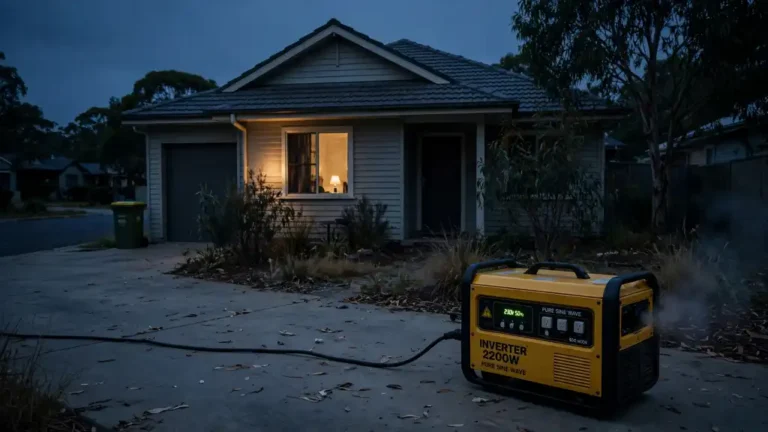
A petrol generator is safe outdoors and dangerous indoors — there is no middle ground. Carbon monoxide is colourless and odourless, and it can build up to deadly levels in minutes indoors. Always run it outside, well away from windows, doors and vents, and fit a battery-operated carbon monoxide alarm.
Never plug a generator into a wall outlet to feed the house wiring — back-feeding can electrocute line workers and bypass your safety switches. To connect a generator to house circuits, a licensed electrical contractor must fit a transfer switch in line with AS/NZS 3000:2018. Keep it dry, use a heavy-duty outdoor-rated extension cord, and look for the Regulatory Compliance Mark (RCM) when you buy. Energy Safe Victoria’s generator safety fact sheet sets out the same rules in full.
Keeping Your Inverter Generator Ready
A generator that will not start is worse than no generator, because you planned around it. Run it for 15 minutes every month or two, under a light load, to keep the fuel fresh. Use fresh unleaded petrol, drain the tank for long storage or use a fuel stabiliser, and check the oil before each use. Store it dry, under cover but well ventilated, with the manual and a litre of the correct oil beside it. When the next trip or storm warning comes, you want a ten-minute job — fuel, oil check, start — not a rescue mission. Among the best inverter generators Australia has to offer, the one that starts first go is the one that earns its keep.
Frequently Asked Questions
What is the difference between an inverter generator and a normal generator?
An inverter generator rebuilds the engine’s rough power as a clean, stable sine wave; a normal generator sends raw power straight to the outlets at a fixed speed. The inverter version is quieter, thriftier at light load and safe for sensitive electronics.
What size inverter generator do I need for camping in Australia?
For camping essentials — lights, phone and laptop charging, a fan and a small fridge — a 1,000W-class inverter such as the Honda EU10i is usually enough. Add a microwave or kettle and step up to the 2,200W class.
Can an inverter generator run a caravan air conditioner?
It depends on the air conditioner. A small rooftop unit can need 2,000W or more plus a large starting surge, so a 2,200W-class inverter may struggle without a soft-start kit. A 3,100W-rated unit or larger is a safer bet.
Can I run two inverter generators in parallel?
Yes, if both models support it. A parallel kit joins two compatible inverters so they run as one machine with roughly double the output — two Honda EU22i units give around 4,400W maximum.
How quiet is an inverter generator?
The quietest models run at around 48–52 dB(A) at 7 metres, about normal conversation level. Budget inverters are louder: the XTM 2000W is 61 dB(A) at half load. Every 10 dB sounds roughly twice as loud.
Can an inverter generator charge a laptop or run a fridge?
Yes. An inverter generator produces a pure sine wave, so it is safe for laptops, chargers, TVs and modern fridge electronics. A 2,200W-class inverter comfortably runs a fridge and freezer together, since each unit runs at roughly 100 to 200W.