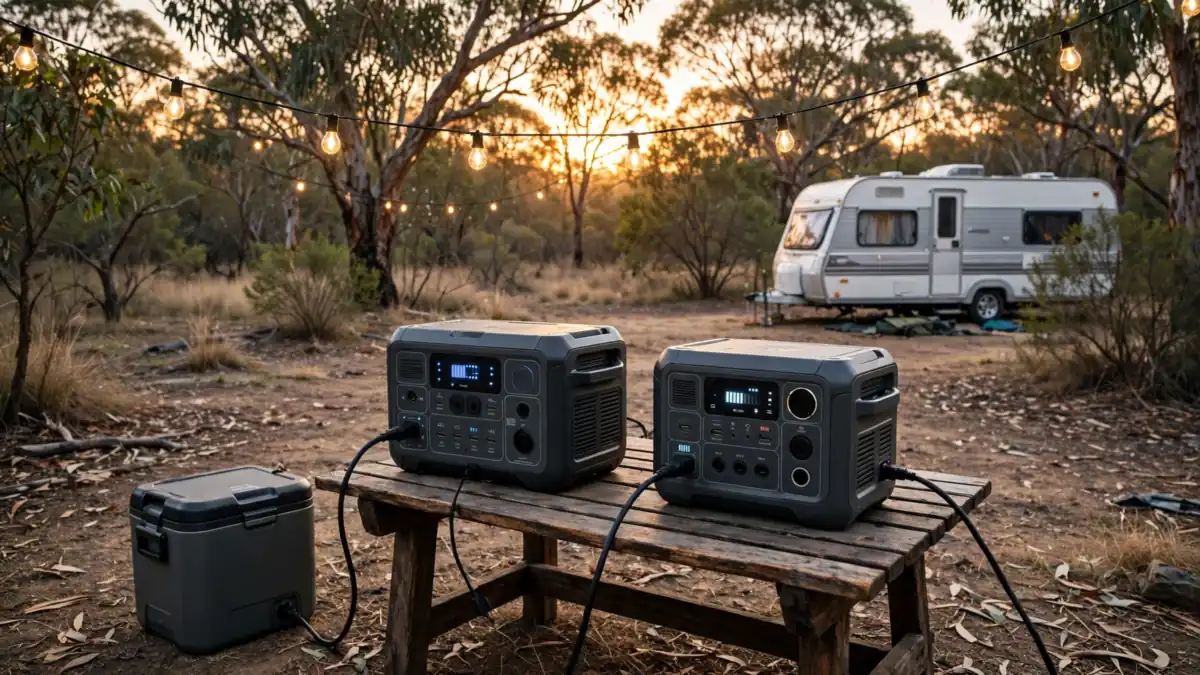
Best Portable Power Stations in Australia: Honest Picks With Checked Prices
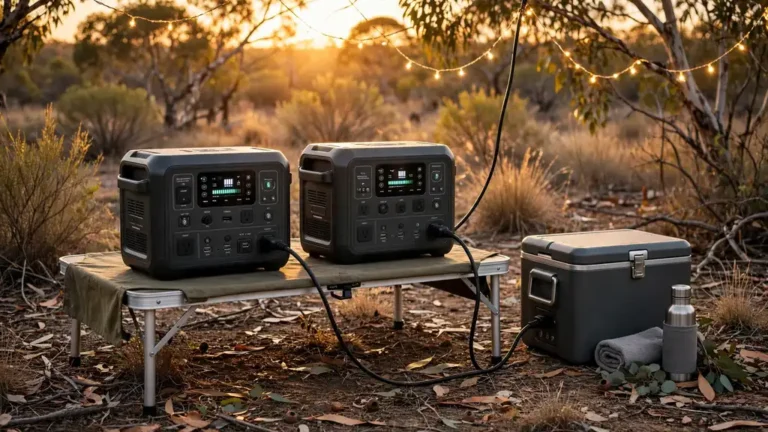
Finding the best portable power station Australia has on shelves right now comes down to three numbers: how much energy it stores (watt-hours), how much power it can deliver at once (watts), and what each stored watt-hour costs you. Everything else — apps, screens, extra ports — is garnish. This guide ranks four lithium iron phosphate (LFP) models that Australian buyers actually cross-shop, with every price checked at two Australian retailers on 23 October 2026. Prices in this category move weekly, so treat the figures as a dated snapshot and check the shelf price before you buy.
Start with size, not brand. If you have not added up your loads yet, our guide to what size generator you need in Australia works through the maths with a fridge, lights and tools — the same arithmetic sizes a power station. Buy the class your loads demand and every pick below becomes a short decision instead of a gamble.
At a glance — the verdict from this guide:
- Best overall: EcoFlow DELTA 2 — the proven 1kWh all-rounder, cheapest per watt-hour at its current EcoFlow AU price
- Best capacity for the money: Bluetti AC180P — 1,440Wh at the same shelf price at two retailers
- Best fast charging and backup: EcoFlow DELTA 3 Plus — full in 56 minutes, sub-10ms UPS switchover
- Best for camping and travel: EcoFlow RIVER 2 Pro — 768Wh at 7.8kg, light enough to move daily
Full reasoning, specs and checked prices for each pick are below.
Best portable power station Australia: the shortlist at a glance
| Model | Capacity | AC output | Weight | Price checked 23 Oct 2026 |
|---|---|---|---|---|
| EcoFlow DELTA 2 | 1,024 Wh | 1,800 W (2,700 W surge) | 12 kg | $899 at EcoFlow AU (was $1,199); $1,199 at Bunnings |
| Bluetti AC180P | 1,440 Wh | 1,800 W (2,700 W Power Lifting) | 17 kg | $1,349 at Jaycar; $1,349 at Road Tech Marine |
| EcoFlow DELTA 3 Plus | 1,024 Wh | 1,800 W (3,600 W surge) | 12.5 kg | $1,399 at EcoFlow AU; $1,399 at The Good Guys |
| EcoFlow RIVER 2 Pro | 768 Wh | 800 W (1,600 W X-Boost) | 7.8 kg | $1,299 at EcoFlow AU; $1,279.77 at LiFePO4 Australia |
All four use LFP cells, all four carry five-year warranties from their makers, and all four can be charged from wall power, solar or a vehicle. The differences that matter are capacity per dollar, charging speed, weight and how each one behaves when the grid drops out. In other words, the best portable power station Australia pick for you is already in the table above — the sections below exist to explain why, model by model.
Best overall: EcoFlow DELTA 2
The DELTA 2 is the default recommendation for most households because it gets the fundamentals right at the sharpest current price. Its 1,024Wh LFP battery is rated for 3,000 cycles to 80 percent capacity, its inverter delivers 1,800W continuously with a 2,700W surge, and X-Boost lets it run some resistive loads up to 2,400W. At EcoFlow Australia’s checked price of $899 — down from $1,199, and still $1,199 at Bunnings — it works out to about $0.88 per watt-hour, the cheapest stored energy in this guide. Shelf prices differ that much between retailers in this category, which is exactly why every pick here was checked twice.
In daily terms, budget roughly 820 usable watt-hours after inverter losses. Against the loads in our sizing calculator — a 150W fridge, 50W of LED lights, a TV and chargers — that is a comfortable evening of blackout cover, or a weekend of camp fridge and lights with a solar top-up. The DELTA 2 accepts up to 500W of solar input and recharges from the wall at 1,200W, reaching 80 percent in about 50 minutes. At 12kg it is luggable rather than light, but it stays put happily in a garage or caravan.
Its other structural advantage is the exit ramp: the DELTA 2 accepts an extra battery, so a household that outgrows one kilowatt-hour can double capacity instead of replacing the unit. If you are torn between this and the Bluetti below, our EcoFlow vs Bluetti comparison puts the two brands head to head on the models Australians cross-shop most.
Best capacity for the money: Bluetti AC180P
The AC180P is the pick when the job is simply to store the most energy under $1,400. It packs 1,440Wh — forty percent more than the DELTA 2 — behind the same 1,800W continuous output, with Bluetti’s Power Lifting mode rated to 2,700W for resistive loads. Both Jaycar and Road Tech Marine listed it at $1,349 on the day we checked, about $0.94 per watt-hour, and the agreement between two unrelated retailers makes that the most solid shelf price in this guide.
That extra capacity is what a full night of fridge cover actually looks like. A 150W fridge draws roughly 1,200Wh across eight hours of compressor time; the AC180P is the only unit here that covers it with margin left for lights and the Wi-Fi router, using the same load figures as our sizing guide. It recharges hard, too: 1,440W of AC input takes it from empty to 80 percent in about 45 minutes, and solar input runs to 500W. Bluetti rates the LFP pack for over 3,500 cycles and backs it with a five-year warranty on the Jaycar listing.
The honest trade-off is weight and pace of life. At 17kg the AC180P is a two-handed lift you plan around, not a grab-and-go box, and it lacks the DELTA 2’s extra-battery growth path in the form most buyers will use. Treat it as a semi-permanent home backup unit that also camps, rather than the other way around, and it earns its place.
Best fast charging and home backup: EcoFlow DELTA 3 Plus
The DELTA 3 Plus is the newest design here, and its party tricks are speed and silence. Same 1,024Wh capacity class as the DELTA 2, but the AC input runs to 1,500W for a full charge in 56 minutes, the surge rating climbs to 3,600W, and solar input doubles to 1,000W across two MPPT inputs — a full solar recharge in about 70 minutes in good sun. Both EcoFlow Australia and The Good Guys listed it at $1,399 when we checked, about $1.37 per watt-hour. You are paying for speed and refinement, not extra storage.
For home backup specifically, one figure stands out: the built-in UPS switches to battery in under 10 milliseconds, fast enough that a desktop PC, NAS or 3D printer should not notice the grid going down. EcoFlow also rates this generation’s LFP cells for 4,000 cycles to 80 percent, seals the battery pack to IP65, and quotes noise under 30dB at moderate loads — the one you can leave running in a bedroom during an outage without it becoming the story of the night. Eleven output ports include two 140W USB-C sockets, which fast-charge modern laptops without their bricks.
Choose it over the DELTA 2 if your outages are short and frequent, if a home office must not blink, or if a big solar array will do the daily charging. Choose the DELTA 2 if you would rather keep $500 and accept slower charging — the stored energy is identical.
Best for camping and travel: EcoFlow RIVER 2 Pro
Every other pick here is a two-handed proposition. The RIVER 2 Pro is not: 768Wh in a 7.8kg box you can carry in one hand, which changes how you camp. It lives in the car, moves to the picnic table, and comes inside at night without a plan. EcoFlow Australia listed it at $1,299 and LiFePO4 Australia at $1,279.77 on check day — call it about $1.67 per watt-hour, the priciest energy in this guide. Portability is what the premium buys.
The output side is honest about its class: 800W continuous, with X-Boost to 1,600W for resistive loads. That runs the camp fridge, lights, phones, a drone charger and a laptop all day, boils nothing quickly, and should not be asked to run a kettle and a microwave in the same thought. Charging is quick — a full wall charge in about 70 minutes — and solar input tops out at 220W, well matched to a single folding panel across a day at camp. The LFP pack is rated for 3,000 cycles and carries the same five-year warranty as its bigger siblings.
One crossover worth knowing: a station this size is also the workshop’s friend for charging cordless tool packs off-grid. If you are estimating how long your tool batteries themselves will run a saw or trimmer, our battery runtime calculator does that maths from the pack’s voltage and amp-hours.
What these stations will and won’t run
Here are the four stations against the loads from our sizing calculator, using the conservative planning figure of 80 percent of rated capacity — the share you can actually spend without draining the pack to empty. Times are for continuous draw; appliances that cycle, like fridges, stretch much further in real use.
| Load | EcoFlow DELTA 2 | Bluetti AC180P | EcoFlow DELTA 3 Plus | EcoFlow RIVER 2 Pro |
|---|---|---|---|---|
| Household fridge (150 W running) | About 5.5 hours of compressor time | About 7.7 hours | About 5.5 hours | About 4.1 hours |
| CPAP machine (40 W) | About 20 hours | About 29 hours | About 20 hours | About 15 hours |
| LED lighting (50 W) | About 16 hours | About 23 hours | About 16 hours | About 12 hours |
| Circular saw (1,200 W) | Runs it — about 40 minutes of continuous cutting | Runs it — about 58 minutes | Runs it — about 40 minutes | Won’t run it — 800 W output limit |
The pattern matters more than any single figure. Capacity buys hours on small, steady loads — the fridge, the CPAP, the lights — and that is where the AC180P’s extra 416Wh quietly wins. Output watts buy permission: the three 1,800W units can start and run a saw, a microwave or a kettle one at a time, while the RIVER 2 Pro’s 800W ceiling keeps it in charger-and-electronics territory.
How to choose the best portable power station Australia homes need
Work through three questions in order. First, energy: add up watt-hours, not watts. A station’s Wh figure divided by your daily load is your runtime; our generator and power station sizing calculator totals both for you from an appliance list. Second, strength: the AC output must beat the biggest single load’s running watts, and the surge rating must beat its start-up spike — motor loads like fridges and compressors decide this, not phone chargers. Third, logistics: weight, charging speed and solar input decide whether the unit actually gets used, or sits in a cupboard as an expensive regret.
On chemistry, there is little left to debate in 2026: every pick here uses LFP, rated for 3,000 to 4,000 cycles before fading to 80 percent — a decade of regular use — and it is the safer, more heat-tolerant chemistry for Australian conditions. Whatever you buy, follow the Queensland Fire Department’s lithium-ion battery safety guidance: charge on a hard, clear surface, use the maker’s charger, and keep any lithium battery out of household rubbish at end of life.
Two buying habits protect you in a category where prices swing this hard. Compare both stores on the day you buy — the $300 gap between EcoFlow’s own store and Bunnings on the DELTA 2 was real on our check day. And register the warranty while the receipt is still in your inbox.
Finally, the verdict pattern of this guide is the honest shape of the market. The best portable power station Australia offers you is the DELTA 2 on value, the AC180P on storage, the DELTA 3 Plus on speed, and the RIVER 2 Pro on weight — in that order of priorities. Match the priority to the job, check the day’s shelf price at two stores the way we did, and the category stops being confusing.
Frequently Asked Questions
What is the best portable power station in Australia for home backup?
For most homes, the Bluetti AC180P: its 1,440Wh is enough for a fridge through the night plus lights and internet, at the firmest checked price in this guide. If a computer or NAS must never blink, the EcoFlow DELTA 3 Plus and its sub-10ms UPS switchover is the better tool despite the smaller battery.
How big a power station do I need to run a fridge?
A typical household fridge draws about 150W running but can spike past 1,000W on compressor start-up. A 1kWh-class station with a 1,800W inverter covers the spike easily and runs the fridge for roughly five to six hours of compressor time — usually a full night, because the compressor cycles off between runs.
Are portable power stations safe to use indoors?
Yes — unlike a petrol generator, a power station produces no exhaust, so indoor use is its main advantage. All four picks use LFP chemistry, the most thermally stable lithium type. Charge on a hard surface away from bedding and soft furnishings, and stop using any unit whose case swells, leaks or smells unusual.
How long will an LFP power station last?
The packs here are rated for 3,000 cycles (DELTA 2, RIVER 2 Pro) to 4,000 cycles (DELTA 3 Plus) before capacity fades to 80 percent. At one full cycle a day, that is roughly eight to ten years; at weekend-camping pace, far longer. All four models carry five-year manufacturer warranties.
Can a portable power station run power tools?
Yes, within its output. An 1,800W station runs most single cordless-tool chargers and corded tools one at a time — a 1,200W circular saw, for example — as long as the surge rating clears the motor’s start-up draw. Smaller 800W units like the RIVER 2 Pro are for chargers and electronics, not for running the saw itself.