Best Generators for Home Backup Australia: Top Picks for Every Budget
Finding the best generators for home backup Australia homes can rely on starts with an honest list of what you need to keep running. A fridge, a few lights, the Wi-Fi router and phone chargers is one job; adding a microwave, a water pump or a small air conditioner is a much bigger one. We compared the current Australian lineups from Honda, Ryobi, Cromtech, Westinghouse and XTM.
Every price below is in Australian dollars, from Bunnings, BCF and Australian generator retailers, checked in November 2026. Prices move, so treat them as a guide, not a quote. If you have not added up your loads yet, our guide to what size generator you need in Australia works through the maths first.
The Short List: Best Generators for Home Backup Australia
Here are the winners.
- Best overall: Honda EU22i 2200W inverter — $1,785, the quietest unit here
- Best value: Ryobi RPGENINV4K 4000W open frame inverter — $999, the most watts per dollar
- Best for bigger loads: Cromtech Outback CTG4500iE 4.5kW inverter — $1,453, remote start and real grunt
- Best quiet mid-size: Westinghouse iGen2600 2600W inverter — $1,349, long runtime
- Best budget: XTM 2000W closed frame inverter — $350, the cheapest clean backup power
Best Overall: Honda EU22i 2200W Inverter Generator
The Honda EU22i is our pick for most households buying a generator for blackouts. Its 2200W maximum and 1800W rated output cover a fridge, lights, TV, laptop and router, and the inverter delivers clean sine-wave power for modern fridge electronics and laptops. Hampton Mowerpower lists it at $1,785 in a November 2026 Black Friday sale (struck-through price $2,499).
Key specs
- Output: 2200W maximum, 1800W rated; engine: Honda GXR120 121cc four-stroke
- Noise: around 48 dB(A) at quarter load, at 7 metres; runtime: around 8 hours at quarter load
- Weight: 21.1kg; Eco-Throttle adjusts engine speed to the load; 4-year domestic warranty
Why it stands out
Quiet running and build quality. At around 48 dB(A) on quarter load it is the easiest generator here to live next to, and the Eco-Throttle sips fuel when the load is light. The four-year domestic warranty and dealer network are the other half of the price. The honest limitation is output: 1800W rated will not run a ducted air conditioner or a bore pump alongside the fridge.
Best Value: Ryobi RPGENINV4K 4000W Open Frame Inverter Generator
The Ryobi RPGENINV4K is the value pick because it gives you more watts for the money. Its 4000W surge and 3100W rated output will run the fridge, a microwave and a water pump in turn. Bunnings lists it at $999.
Key specs
- Output: 4000W surge, 3100W rated; open frame inverter design
- Pure sine wave inverter output, safe for sensitive electronics
Why it stands out
Watts per dollar. A 3100W rated output moves you from blackout essentials into genuine comfort — the microwave, the kettle one at a time, a pump — without jumping to a $2,000-plus machine. The honest limitation is the open frame: it is louder than the enclosed inverters here, with no published noise figure.
Best for Bigger Loads: Cromtech Outback CTG4500iE 4.5kW Inverter Generator
When the job includes a pump, power tools or several appliances at once, the Cromtech Outback CTG4500iE is the pick. Its 4500W maximum output is the largest here, and the remote start works from up to 20 metres away. Macfarlane Generators lists it at $1,453.
Key specs
- Output: 4500W maximum, 3700W continuous; pure sine wave inverter
- Remote start and electric start, operable from up to 20 metres; digital display showing volts, hertz and hours
- Noise: 55–60 dB at 7 metres; runtime: 4–12 hours depending on load; wheels and extendable handle; 1-year warranty
Why it stands out
Capacity plus convenience. Remote start sounds like a luxury until you are starting a generator in the rain at midnight, and the 3700W continuous output handles loads the smaller inverters cannot — a pump plus the fridge, or a circular saw on site. The honest limitation is the warranty: one year, against Honda’s four, and parts support is thinner.
Best Quiet Mid-Size: Westinghouse iGen2600 2600W Inverter Generator
The Westinghouse iGen2600 sits between the 2kW suitcase class and the big open-frame units. Its 2600W maximum and 2200W running output handle the fridge plus a few extras, and the 5-litre tank stretches to up to 19 hours. Bunnings lists it at $1,349.
Key specs
- Output: 2600W maximum, 2200W running; fuel tank: 5 litres
- Runtime: up to 19 hours; the highest starting power in its class, per Bunnings
Why it stands out
Runtime. Up to 19 hours from a 5-litre tank means fewer midnight refuels, and the 2200W running output covers the fridge’s start-up surge with headroom the 1800W-rated units lack. The honest limitation is brand depth in Australia: Westinghouse Outdoor Power is a smaller presence here than Honda or Ryobi.
Best Budget: XTM 2000W Closed Frame Inverter Generator
The XTM 2000W closed frame inverter is the cheapest honest way into home backup power. Its 2000W maximum and 1800W rated output cover the blackout essentials — fridge, lights, router, chargers — with pure sine wave output for laptops and modern fridge electronics. BCF lists it at $350 on clearance.
Key specs
- Output: 2000W maximum, 1800W rated; engine: 78.5cc four-stroke, 4-litre tank
- Weight: 20kg; noise: 61 dB(A) at half load and 63 dB(A) at full load, at 7 metres; 1-year warranty
- Outlets: 2 x 240V AC, 1 x 12V DC, 1 x USB; low and no-oil protection
Why it stands out
Price. At $350 it undercuts the premium 2kW inverters by more than $1,400 while covering the same essential loads, and BCF’s national stores make it easy to buy and return. The honest limitation is noise: 61 dB(A) at half load is noticeably louder than the Honda’s 48 dB, and the one-year warranty is short.
Also Worth a Look
Also worth a look: the MaxWatt MX2800iSE 2800W inverter ($1,045 at Macfarlane Generators, electric start, 2500W rated), the Briggs & Stratton P2400 2400W inverter ($1,469 at GO Industrial, with CO Guard, 1800W running, 22.8kg, 3-year domestic warranty), and the Yamaha EF2000iS 2000W inverter (recommended retail price $2,149, 10.5 hours at quarter load, 4-year warranty). These three are the next tier down — MaxWatt for value electric start, Briggs & Stratton for the CO Guard safety feature, Yamaha as the premium Honda alternative.
How to Choose the Best Generators for Home Backup Australia Has to Offer
Here is what actually matters when you compare the best generators for home backup Australia has on offer.
Size it from your load list, not the box
Add up the running watts of everything you want on at once, then add the single biggest start-up surge — a fridge compressor can demand around 1,200W to start.
Rated output matters more than maximum output
The big number on the carton is the peak a generator holds for a few seconds. Your loads care about the continuous rating underneath it.
Inverter vs conventional
Inverter generators produce clean, stable power for laptops, TVs and modern fridge electronics, and they throttle down under light load. Conventional open-frame generators cost less per watt and suit building sites and tool loads. For home backup, an inverter is the right default.
Noise: the number neighbours judge you by
Noise is measured in decibels at seven metres, and every 10 dB sounds roughly twice as loud. The Honda’s 48 dB(A) is conversation-quiet; the XTM’s 61 dB(A) at half load is closer to a vacuum cleaner.
Runtime and refuelling
Check the tank size and runtime at quarter load, not the headline hours at idle. The Westinghouse runs 19 hours on 5 litres — enough for the night without a refuel. Refuel only with the engine off and cool.
What a Home Backup Generator Will and Won’t Run
A 2,200W-class inverter comfortably runs a fridge and freezer, LED lights, the Wi-Fi router, phone and laptop charging, a TV and a fan. Step up to the 3,100–3,700W rated class and you add a microwave, a kettle or a water pump, one at a time.
What it will not run is the heavy fixed gear: ducted air conditioning, a full-size electric oven, an electric hot water system or a large bore pump. Those need a permanently installed standby generator with a transfer switch, fitted by a licensed electrician.
Running Your Generator Safely
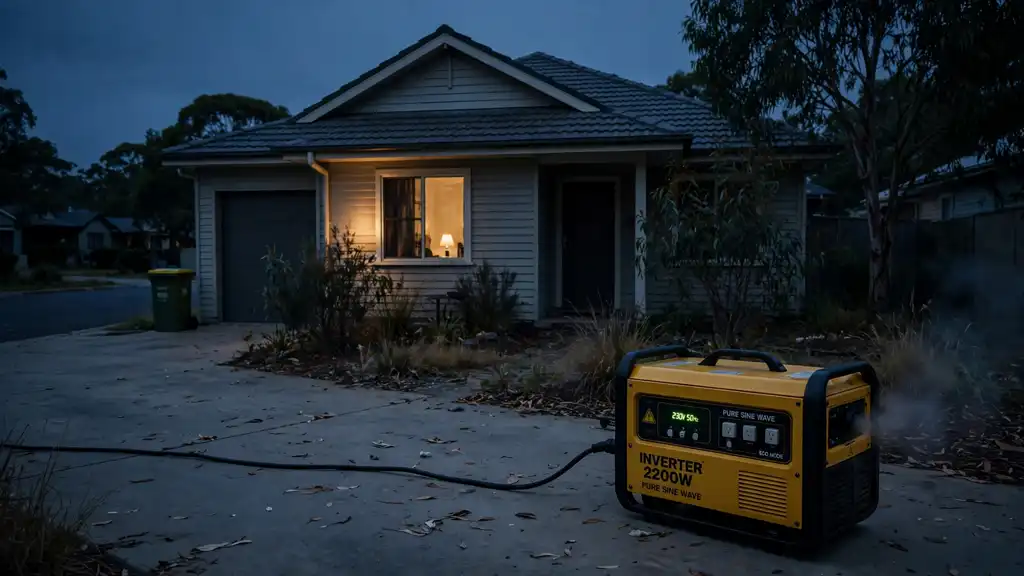
A petrol generator is safe outdoors and dangerous indoors — there is no middle ground. Carbon monoxide is colourless and odourless, and it can build up to deadly levels in minutes inside a home or a garage. Always run the generator outside, well away from windows, doors and vents. Fit a battery-operated carbon monoxide alarm in the house, and if anyone feels sick, dizzy or weak while it runs, move to fresh air immediately.
Never plug a generator into a wall outlet to feed the house wiring — back-feeding can electrocute line workers and bypass your safety switches. To connect a generator to house circuits, a licensed electrical contractor must fit a transfer switch in line with AS/NZS 3000:2018. Keep the generator dry and your hands dry before touching it, and use a heavy-duty outdoor-rated extension cord. NT WorkSafe’s safe use of generators in domestic situations bulletin sets out the same rules in full.
Generator or Portable Power Station?
A generator and a power station solve different halves of the blackout problem. A power station is silent, safe indoors and instant, running the fridge, lights and internet through the first night without fuel, fumes or noise. A generator runs for as long as you have petrol, and it starts motor loads a battery station cannot.
Our best portable power stations guide ranks the battery options Australians cross-shop, and our EcoFlow vs Bluetti comparison puts the two leading brands head to head. Short outages: start with a station. Long ones: start with a generator.
Keeping Your Generator Ready for the Next Blackout
A backup generator that will not start is worse than no generator, because you planned around it. Run it for 15 minutes every month or two, under a light load, to keep the fuel fresh and the carburettor clear. Use fresh unleaded petrol, and drain the tank for long storage or use a fuel stabiliser. Check the oil before each use.
Store the generator dry, under cover but well ventilated, with the fuel cap tight. Keep the manual, spark plug spanner and a litre of the correct oil with the machine. When the next storm warning comes, you want a ten-minute job — fuel, oil check, start — not a rescue mission. Among the best generators for home backup Australia has on offer, the one that starts first go is the one that earns its keep.
Frequently Asked Questions
What size generator do I need for home backup in Australia?
For blackout essentials — fridge, lights, TV, devices and a router — a 2,200W inverter generator usually covers the running load and the fridge’s start-up surge. Add a water pump, regular microwave use or power tools and step up to around 3,500W. Running most of a home at once takes 5,000W or more, and whole-home comfort including ducted air conditioning is standby-generator territory.
Can a generator run a fridge and freezer during a blackout?
Yes. Each unit runs at roughly 100 to 200W but can surge to 800–1,200W on compressor start, so a 2,200W-class inverter comfortably handles a fridge and freezer together plus lights and chargers, because the two compressors rarely start in the same second.
Is it safe to run a generator in a garage?
No. Never run a generator indoors, in a garage or in any partly enclosed space. Generator exhaust contains carbon monoxide, a colourless and odourless gas that can build up to deadly levels in minutes, and opening doors or windows does not supply enough fresh air. Always run the generator outside, well away from windows, doors and vents, and fit a battery-operated carbon monoxide alarm in the house.
How long will a generator run on a tank of fuel?
It depends on the tank and the load. The Westinghouse iGen2600 runs up to 19 hours from its 5-litre tank, the Honda EU22i runs around eight hours at quarter load, and the Cromtech CTG4500iE runs 4–12 hours depending on load. Refuel only with the engine switched off and cool, and never store more fuel than you reasonably need.
Generator or portable power station — which should I buy?
Buy a portable power station if your outages are short, you need silent power indoors, and your loads are light — it runs the fridge, lights and internet with no fuel and no fumes. Buy a generator if outages run for days or you need to run motor loads like pumps and tools, because it keeps going for as long as you have petrol. Many households end up with both.
Can I plug a generator straight into my house wiring?
No. Never plug a generator into a wall outlet to feed the house wiring — this is called back-feeding, and it can electrocute line workers and bypass your safety switches. If you want the generator connected to house circuits, a licensed electrical contractor must fit a transfer switch in line with AS/NZS 3000:2018.