Circular Saw vs Mitre Saw vs Table Saw: Which One First?
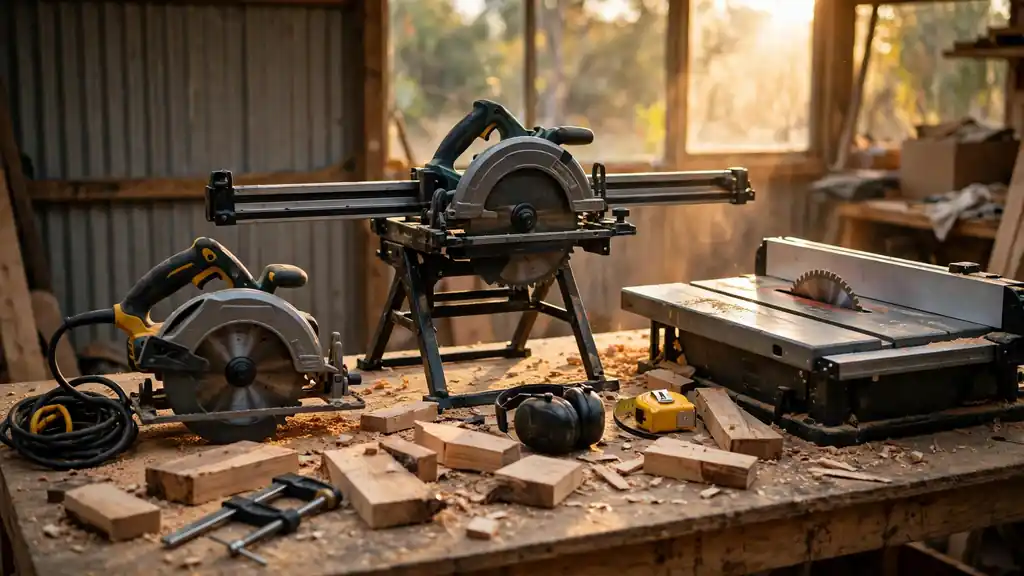
Buy the circular saw first, add the mitre saw second, and buy the table saw only when repeatable ripping becomes the bottleneck in your work. That is the short answer to circular saw vs mitre saw vs table saw, and it holds for most Australian home workshops: the circular saw breaks down sheets and cuts framing timber anywhere, the mitre saw makes the same crosscut at the same angle forty times without re-measuring, and the table saw rips boards to identical widths all day. This guide compares the three on the cuts they own, what each one costs as a complete setup, and the order to buy them in.
Circular Saw vs Mitre Saw vs Table Saw: The Shortlist
| Saw | Cut it owns | Cut it cannot do well | Typical starting price |
|---|---|---|---|
| Circular saw | Breaking down sheets, straight cuts anywhere | Repeatable angles, identical widths | $79 |
| Mitre saw | Repeated crosscuts and angles in long stock | Ripping, sheet goods, curves | $389 |
| Table saw | Repeated rips to identical widths | Full sheets without outfeed support, curves | $549 |
The starting prices are for corded Ryobi models at Bunnings, checked 20 November 2026: a 1500W 184mm circular saw at $79, a 2000W 254mm dual-bevel sliding mitre saw at $389, and an 1800W 254mm table saw at $549.
The One Question That Settles It
Ask what moves during the cut: the blade or the timber. On a circular saw and a mitre saw, the blade travels and the work stays still. On a table saw, the work travels past a fixed blade. That single difference decides accuracy, space and safety more than motor watts ever will.
When the blade moves, you bring the tool to the work. A circular saw cuts a sheet lying on sawhorses in the driveway; a mitre saw crosscuts a 5.4-metre length of decking that never has to be lifted onto anything. When the timber moves, the machine holds the reference: the table saw fence sets the width once and every board after it comes off identical, which is why joiners and cabinet makers build their shops around one.
The second question is how many times you make the same cut. A circular saw with a clamped straightedge makes a dead-straight cut — once. Make the same cut forty times and repositioning the guide forty times becomes the whole job. A mitre saw or a table saw pays for itself in repetition: set the stop or the fence once, then feed stock through. If your next project has four cuts, buy the circular saw. If it has four hundred, buy the stationary machine.
Circular Saw vs Mitre Saw vs Table Saw: What Each One Actually Does
The circular saw: the first saw to own
A circular saw is a hand-held disc saw, usually 184mm or 165mm in Australia, that cuts in a straight line through timber, sheet goods and, with the right blade, metal and masonry. Its depth of cut at 90 degrees is about 55 to 60mm on a 184mm blade, enough for framing timber and every sheet good in one pass, and it drops to about 40mm at a 45-degree bevel. It stores on a shelf, runs off a standard 240V outlet or an 18V battery, and goes to the work instead of the work coming to it.
Its weakness is repeatability, not accuracy. Clamp a straightedge to the sheet and a circular saw cuts as straight as a table saw; the cost is setup time on every cut. It also needs the sheet supported properly — a full sheet of plywood sags and pinches the blade if it is only held at the ends, so two sawhorses and a sacrificial sheet of foam or offcuts underneath are part of the kit. For a full rundown of current models, read our best circular saws guide.
The mitre saw: the crosscut specialist
A mitre saw holds the stock against a fence while a pivoting head drops a spinning blade through it. It makes straight crosscuts, mitre cuts, bevel cuts and compound cuts — the angled joints in skirting, architraves, decking and framing — and it makes them at the same setting again and again. A sliding mitre saw adds rails so the head travels forward, which lifts the crosscut capacity from about 140mm to about 300mm on a 254mm blade.
What it cannot do is rip. There is no fence to guide a lengthwise cut and no safe way to feed a board along the blade, so a mitre saw never replaces a table saw for ripping, and it never handles sheet goods — a 1,200mm-wide sheet will not fit under the head. It also needs room: a mitre saw cutting 5.4-metre lengths needs clear space on both sides, and a stand is close to essential rather than optional. Our best mitre saws guide covers the current Australian range.
The table saw: the ripping machine
A table saw is a fixed blade spinning up through a table, with a rip fence that sets the width of cut. Push the board past the blade and it comes off at exactly the fence setting, board after board. It is the most accurate ripping tool in a home workshop and the most dangerous machine in it, because the same fixed blade that gives repeatability also gives kickback: a board that twists or pinches behind the blade can be thrown back at the operator in a fraction of a second.
The riving knife is the defence that matters. It sits behind the blade, rises and falls with it, and keeps the cut open so the board cannot pinch. Any table saw bought in Australia today should have one fitted, and it should never be removed for through-cuts. The other number that matters is the fence: a fence that deflects under hand pressure or drifts out of parallel produces tapered rips no motor can fix. Motor power is rarely the limit in a home shop; the fence is. Read our best table saws guide before choosing one.
The Cost of Each Saw, Done Properly
A tool-only price is not a working setup. Each saw needs blades, guides or supports before it earns its keep, and the extras change the ranking. A circular saw needs a good 40-tooth combination blade — about $40 to $70 — and a straightedge guide, which can be a clamped length of straight timber at no cost or a bought guide rail. A mitre saw needs a stand, roughly $100 to $250, and a fine-tooth blade for trim work. A table saw needs an outfeed support for long boards, a push stick, and a decent rip blade, plus the floor space to feed a 2.4-metre board through it.
| Saw | Tool from | Setup extras | Working setup from about |
|---|---|---|---|
| Circular saw | $79 | Blade + straightedge, about $60 | $140 |
| Mitre saw | $389 | Stand + trim blade, about $180 | $570 |
| Table saw | $549 | Outfeed support + blades, about $150 | $700 |
Two costs hide in the cordless versions. A cordless circular saw or mitre saw sold as a skin needs batteries and a charger if you are not already on that platform — a single 5.0Ah battery and charger can add $200 or more — so compare kit prices, not skin prices, when you are starting from nothing.
Which Saw First? A Buying Order That Fits Real Projects
The order depends on the work, but for most people it runs circular saw, mitre saw, table saw. A circular saw with a straightedge handles sheet breakdown, framing cuts and decking boards — the bulk of first projects — for about $140 as a working setup. Add the mitre saw second, when trim, decking or framing means dozens of crosscuts at set angles. Buy the table saw third, when milling solid stock to repeatable widths becomes the constraint, or when cabinet work means ripping sheet after sheet to the same width.
There are exceptions. If your first project is a deck, the mitre saw earns its place on day one, because every board is a crosscut at a set length and the saw pays for itself in an afternoon. If you are building cabinets from plywood, a circular saw with a guide rail does the sheet work and a table saw does the repeatable rips — the mitre saw can wait. If you only ever cut firewood-length timber to size, a circular saw alone may be all you ever need, and the money is better spent on blades.
Safety Differences Worth Knowing Before You Buy
All three saws cut fast and all three bite, but they bite differently. A circular saw kicks back when the blade binds in a closing cut, usually because the offcut sags — support both sides of the cut and let the offcut fall free. A mitre saw throws small offcuts when they are trapped between blade and fence — keep hands 150mm from the blade path and never cross your arms over it. A table saw throws the workpiece itself, and it does so faster than you can react, which is why the riving knife, a push stick and standing to the side of the blade line are not optional extras.
Circular Saw vs Mitre Saw vs Table Saw: FAQs
Can a circular saw replace a table saw?
For breaking down sheets and one-off straight cuts, yes — a circular saw with a clamped straightedge cuts as straight as a table saw. It cannot replace a table saw for repeated rips to identical widths, because every cut needs the guide repositioned and measured again. If your work is mostly one-off cuts, the circular saw is enough; if it is repeated widths, you need the table saw fence.
Can a mitre saw replace a circular saw?
No. A mitre saw only crosscuts stock that fits under its head and against its fence — it cannot rip a board lengthwise and it cannot cut sheet goods. A circular saw goes to the work and cuts full sheets. The two complement each other: the circular saw breaks material down, the mitre saw cuts it to finished length at set angles.
Do I need all three saws?
Most home workshops end up with two, and serious woodworkers end up with all three plus a track saw. Start with the circular saw, add the mitre saw when repeated crosscuts dominate your projects, and add the table saw when repeatable ripping becomes the bottleneck. Buying all three at once before you know your work wastes money on the machine you will use least.
What size mitre saw do I need?
A 254mm sliding mitre saw covers most home work: about 300mm of crosscut capacity, enough for decking boards, skirting and framing timber up to 90mm thick. A 210mm non-sliding saw is cheaper and lighter but tops out near 140mm of crosscut, which rules out wide boards. A 305mm saw suits large trim and hardwood framing but costs more and needs a bigger stand.
Is a table saw too dangerous for a home workshop?
A table saw is the most dangerous machine in most workshops, but it is manageable with the right habits: riving knife always fitted, crown guard on for through-cuts, push stick for narrow rips, fence checked parallel before work, and standing to the side of the blade line rather than directly behind the board. If those habits sound like too much discipline, a track saw gives table-saw straightness on sheets with far less risk.
Start with the circular saw, add the mitre saw when angles and repetition arrive, and buy the table saw when identical widths become the work. That order is the cheapest way to answer circular saw vs mitre saw vs table saw in your own workshop — and if the table saw never becomes necessary, the money stays in blades and timber instead of a machine gathering dust.